
The morning they opened registration for this year’s Silver State 50/50, I had my finger on the button to sign up. I hadn’t raced in over a year, and I missed it!
Friday afternoon, I texted Jenelle to see if she wanted to carpool. (Hooray for being vaccinated and being able to share rides again!) She said yes, and here’s how the conversation went down after that:
Me: Are you doing a drop bag:
Jenelle: Maybe. I need a backup pair of shoes.
Jenelle: Actually, JP will be at Peavine. I can just ask him to bring them.
Me: Sounds good. Ask him to bring rain jackets for us too, just in case! Ha ha JK.
Jenelle: [scared-face emoji, crazy-face emoji]
Me: Yeah, rolling the dice on that one!
Me: Oh shit, never mind. I just checked the forecast again. Chance of thunderstorms has increased to 60% and moved to 11:00 AM, with a high temp of 62 in Reno.
Me: I’m going to run with a vest and carry a rain jacket and sleeves.
So, that turned out to be the best decision I made in the whole race. Maybe this whole year.
In the morning at the start, I reveled in the joy of seeing so many friends again. That was the part I had been looking forward to the most. Not even individual friends so much (though, that too), but just being in a community of friends again. Ask, and Silver State Striders shall provide!
 |
| On the start line with Jenelle |
 |
| Sean and Alex on the start line |
I lined up with Jenelle, and RD John Trent gave us a few inspiring words about our friend Lucas, whom we lost this past year. That sense of community around here - it extends to those who can no longer be a part of it. With that, we were off into a beautiful high desert sunrise.
Most of these early climbing miles aren’t too steep, so I found myself running most of them. Still, race pace was an uncomfortable concept. It had been so long since I’d raced! I found myself thinking it felt fast.

 |
Early miles climbing up behind Jenelle |
I chatted with Jenelle a bit and let her pull me upward. Eventually though, I counseled myself to be smart about my pace, and she slowly pulled ahead. I would run basically solo for the next 20 miles after that.
At mile 12, the folks at the Peavine Summit aid station took good care of me, including friends JP and George. This is the highpoint of the course, and 50 mile runners would visit it three times throughout the day.
After Peavine1, runners head out for a 7-mile loop known as “Jimmy’s Loop.” This is a new section of the course since the last time I ran this race, and it essentially replaces the descent and returning climb from Sandy Hill to Riverbend and back. I’d heard it was technical and steep, and the race website said that it added to the overall climbing/descending of the course.
 |
| Jimmy's Loop |
All of that turned out to be true, but it was also beautiful. I didn’t see another soul on the whole loop, and the sky was huge, with magnificent clouds rolling around it. Flowers, birdsong, and the rhythm of a steady pace down the trail all made for calm and joyous morning.

I swung by the Peavine AS for the second time before heading downhill toward the Long Valley Loop. Katie and Annie Trent had made camp a mile or two down the trail, and they cheered me enthusiastically.


 |
| Big trees and cool rocks in Long Valley |
I was moving along feeling awesome, when all of a sudden, CRACKBOOM! Thunder. The kind that’s close and loud and crackles right overhead.
It seemed to come out of nowhere. I’d been watching the increasing clouds all morning, but there’d been no distant rumbles, no hint that the storm was nearly upon me.
I pulled my sleeve back to check my watch. 11:04. Well, the national weather service pretty much nailed that one.
Things stayed dry, with a few more thunderclaps that weren’t quite as close as that first one. I rolled into the Long Valley aid station where the ladies took great care of me and served me some of that delicious GU Hibiscus Tea electrolyte drink.
“I’m hoping that lightning goes away,” I confessed while they filled my bottles.
“Oh,” one replied, “yeah, it must have been a lot closer to where you were.”
They seemed less concerned about it than I was, which was simultaneously reassuring and disconcerting. When I left the aid station, would I be heading back into the storm?
Not long after leaving the aid station, I passed a runner who looked to be struggling. He was the first runner I’d seen for miles. I watched the dirt of the trail intensely for signs of raindrops as the sound of thunder around me came with increasing frequency.
Eventually, a gentle rain began to fall. I gave it about 20 seconds to make sure it wasn’t just teasing me, and then I promptly took my pack off and put my rain jacket on. I knew I didn’t want to end up too wet before I got my rain jacket on.
It was the right call, as soon my gentle rain turned into a heavy rain, followed by a downpour. When it started to hail, I laughed out loud. Seriously? Well, yes, I told myself, thunderstorms usually come with hail.
I was only a mile or so past the Long Valley aid station at this point, which meant I had about 3 miles to go to get to the aid station at Dog Valley. I had on my super warm sleeves from the Pocatello 50M under my jacket, and I felt warm enough so far, even as the hail stung my bare legs. Now I could see the lightning every time it lit up my surroundings, and I would grit my teeth until the deafening cracks that followed made me instinctively wince and duck my head.
After enduring a particularly terrifying thunderstorm at Hardrock in 2012, I am not one to get overly afraid in a thunderstorm (until things reach that particularly terrifying point, and then I freak out). Still, being alone, soaking wet, pummeled by hail, with lightning constantly cracking around you - I knew it wasn’t the best place to be. I also knew my best move was just to keep moving forward to that next aid station.
I pulled my headphones out and plugged in one ear. Although I could barely hear it over the constant thunder, the music helped distract me and calm my nerves a bit. I haven’t listened to music in a race in well over a decade, but I was happy to have it at Silver State this year!
If there’s one thing weather like this does, it’s motivate you. I dug in and cranked, knowing I still had another two miles to get to Dog Valley. Soon, the trail started to turn muddy, and suddenly, I was overcome with an intense feeling of dread.
Lightning is not great, but there is nothing more terrifying than Peavine mud.
By this point, water was seeping in through my collar, and I was beginning to get a bit wet. I was still warm enough, but a solid wind whirled about, and I knew the combination of wet and wind could be as deadly as a lightning strike.
These worries tugged at the back of my mind, when suddenly, there in the distance was Brandon Dey and his “Big Ball of Dildos” costume. It says a lot about my state of mind that I did not bat an eye at this bizarre costume (which I think was actually just supposed to be a crazy alien costume …?) and instead met his whoops and hollers with whoops and hollers of my own. Dog Valley Aid Station!
 |
| Brandon and his crazy "alien" costume (photo: Valerie Hewitt) |
As I approached, captain Valerie Hewitt immediately let me know that I would have to stop there because we were on lightning hold. It makes perfect sense, given the circumstances. Still, my first thought was, “Oh no, if I can’t keep moving, I’m going to get hypothermic real quick.”
Little did I know how prepared the Dog Valley team was.
When I ducked into the tent I was greeted by Jenelle, Sean, and E.J. among a group of about 5 runners. I have never been so happy to see a crowd of friendly faces, and my attitude immediately shifted from one of worry to one of joy.
 |
| Jenelle, Sean, E.J. and crew. How could you not be stoked upon arriving to the aid station to these faces? |
“Heeeeeey!” they all cried upon seeing me.
“Come have a seat!” called Sean.
“Do you want some broth?” offered Janelle.
“There are more blankets,” someone said. And I noticed then that everyone was wrapped in furry blankets and sleeping bags.
Every thought of “keep moving” was instantly erased, and I happily made my way over to the proffered seat and blanket. We exchanged survival stories as the hail thrummed on the tent and thunder cracked overhead. Sean had survived an incredibly close call, and we were all grateful not to be out there for the time being. When the volunteers pulled out the Pendleton whiskey, I knew I had found my people.
 |
| Cheers! The ground behind me is white because it is covered in hailstones, which you can see are still coming down hard. (Photo: Valerie Hewitt) |
 |
| Sean regales us with lightning tales (photo: Valerie Hewitt) |
I sat there for 20 minutes (Thank you, E.J., for reminding me to stop my watch!), but it all seemed to go by in an instant. Fresh quesadillas, warm broth, and whiskey shots will do that. Sean had been the first to arrive after the lightning hold had been enacted, and I think he was probably there for at least 45 minutes.
Eventually, the lightning abated, and Valerie decided we were safe to continue. By that time there was a crowd of 12 or more, and we all set off into the rain, ready to meet whatever lay ahead.
It was nice to be sharing the trail with Jenelle again, but the conditions were so challenging as to be ludicrous. I don’t mean that it was still raining (which it was) or that my hands were too cold to open a GU packet (which they were). No. I mean that mud. That Peavine, shoe-sticking, trail-sliding, getting-nowhere, slopfest mud. If you’ve ever tried to run on Peavine or nearby Reno trails anytime after a rain or snow storm, you know exactly what I mean.
In some areas, it was so wet that every footfall slid out from under us, like some malicious slapstick comedy, utterly preventing forward motion. But those weren’t the worst parts. No, Peavine has this very special sticky mud. In the sticky-mud stretches, one footfall adds about an inch of mud to your shoes, and it does not come off. With each step, more mud clings. Within seconds, each shoe weighs 10 pounds, and the rounded ball of mud on the bottom gives you no control whatsoever. It’s frustrating, exhausting, and injury-inducing.
So, this is what Peavine had for us as we trekked determinedly upward, through the cold, wind, and rain, toward our next aid station at Sandy Hill. At one point, I looked up to see a runner in the distance trying desperately to keep his feet under him - right foot, left foot, right foot slipping again and again, until he finally reached a desperate hand out onto the ground in front of him. I couldn’t even laugh because it was a fate that awaited us all.
After the initial climb, we hit a long stretch of flat road that should have been fast, gravy miles. Instead, it was covered with sticky mud. Slow, soul-sucking, and exhausting.
The Sandy Hill aid station was staffed by dear friends of mine, and I arrived filled with relief. One more milestone checked off on the way to the final Peavine summit, after which, I could start heading down and get off this mountain. (I carefully refrained from calling it "this damn mountain" just there, because I do not want insult Mother Peavine.)
Here is where I would like to take a moment to explain how Sean, who had been running far ahead of me all day, put everyone else and their safety ahead of his own need to race that day. Our friend Alex, who was also Sean’s good training buddy, had become severely hypothermic and was recovering in someone’s truck at Sandy Hill. Sean wouldn’t leave until he’d made sure everything was okay and he’d contacted Alex’s wife, meaning Jenelle and I left that aid station ahead of him.
She and I were hiking and chatting, when suddenly we heard Sean call out from behind. We turned to see him waving his poles frantically at us. We’d missed a turn. Crap! Jenelle turned around and headed back toward him, while I yelled as loud as I could to a runner ahead of us, who I couldn’t see anymore around a corner, but whom I knew was up there, ignorant of his mistake.
Sean flew by me up the trail to track down the missing runner while Jenelle and I gathered sticks to create a big arrow, hoping to mark the turn more clearly so that runners behind us wouldn’t make the same mistake. I looked up to see Sean, who, after retrieving the runner, was on his phone calling ahead to the next aid station to let them know the turn might need to be remarked since the rain had washed the chalk away. (A short while later, we encountered a jeep of volunteers coming down to take care of it.) Later, at Peavine aid, I heard Sean checking in with the volunteers about the status of another runner (possibly Alex).
Thank you, Sean, for taking care of all of us!
The rest of the day was mostly more of the same (rain, wind, mud), except that after Peavine, there is a whole lot of downhill. I left the summit still in Jenelle’s company, and tried to keep my downhill running engines on high. My fingers were still fairly useless, and I was keen to get down to warmer climes.
 |
| Leaving Peavine for the final time, with our cups of hot broth. (photo: Mat Glaser) |
After a couple of miles, Jenelle slowly pulled away. By the time I hit the aid station with only 5 ½ miles to go, my hands were warm and my feet were trashed. So I slowed to a more casual pace.
I closed in on the finish, and the Reno skyline, all sparkling and washed clean by the rain, was beautiful. I smiled, reflecting already on what an adventure the day had been. My first Silver State 50M, in 2008, had been sunny and 98F. People ran out of water and suffered severe dehydration. It was like the polar opposite of this day. Mother Peavine - she’ll deal you every hand in the deck, and you’d best be prepared.
Jenelle was at the finish line to greet me, along with Steve, Gia, and other running friends. Somehow, Jenelle and I finished 2nd and 3rd for the women, with our friend Amber taking the win. It felt crazy because I hadn’t even been thinking of time or performance since just before Dog Valley. What? Third place? You mean there are places in this thing? Was this a race?
 |
| Finished! |
 |
There were hugs all around (hey, we’re all vaccinated, it's cool) and we all just laughed at the crazy day we’d survived. It couldn’t be over until we cheered Sean across the line (who, any other day, would have long since finished), and it was such a joy to see him run it in.
If my sense of excited anticipation for this event was about a return to my running community, I don’t think I could have asked for a more bonding experience than this one. I know there were a lot of people out there whom I didn't get to see, including runners in the 50K. But we all experienced a truly special day out there together, not to mention an incredible sense of accomplishment.
Huge thanks to the Silver State Striders, John Trent, and all the incredible volunteers who braved the lightning and mud to take care of us. Special shoutout to the Dog Valley rockstars. Next time, I won’t wait 10 years before coming back to this race!
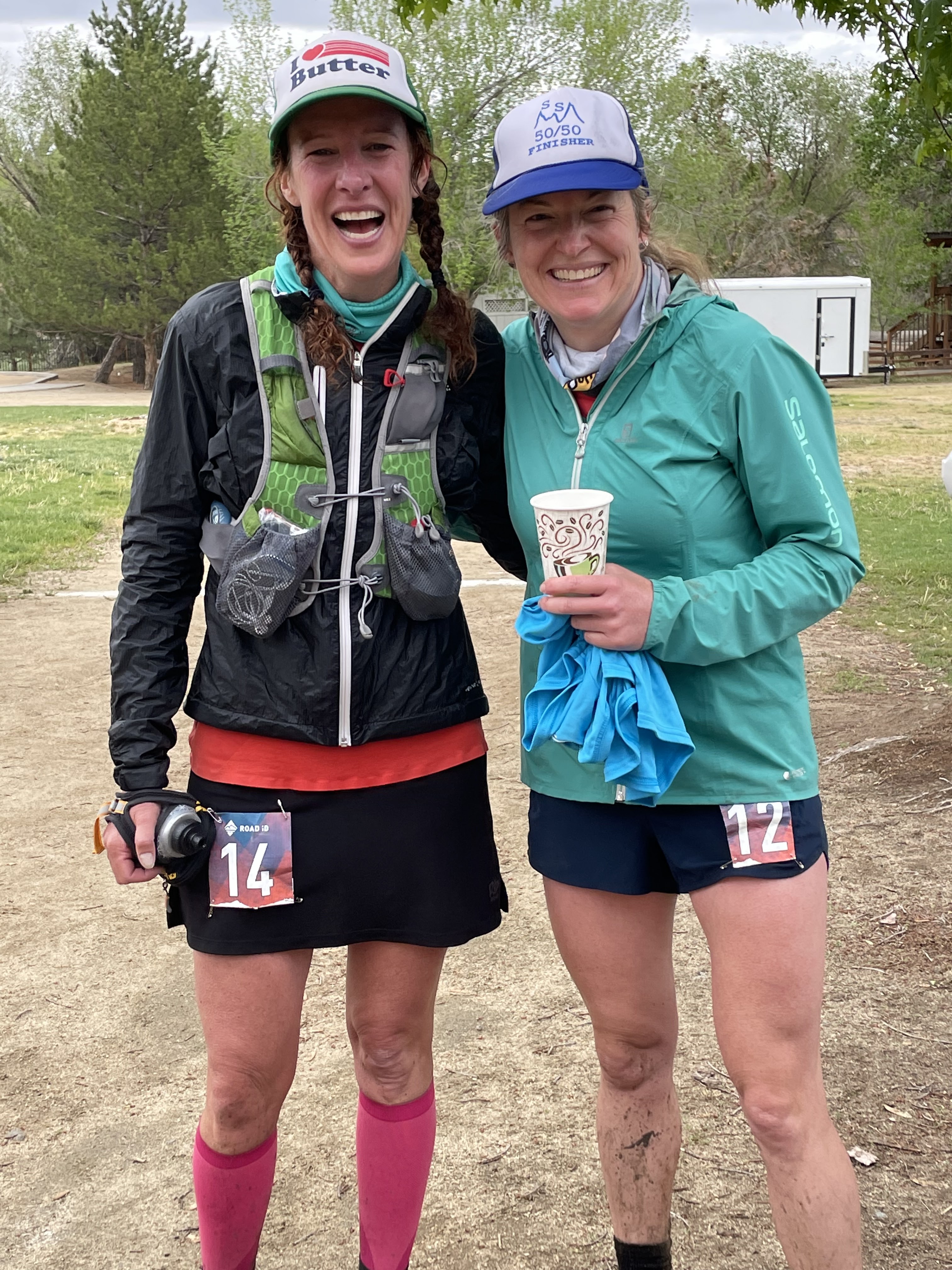 |
| Muddy, wet, and stoked. At the finish line with Jenelle. |


