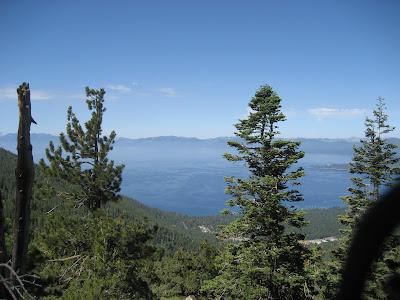
The fog rested heavy on Lake Tahoe, as we cruised along its west shore heading south. Having lost the who’s-drivingro-sham-bo, I was now steering my Subaru through the early morning chill, one hand on the wheel, the other wrapped tightly around an insulated Tahoe Rim Trail coffee mug. Sarah and Camille warmed their hands on identical mugs, while Sarah browsed through several notebooks of CD’s for some tunes.
“So, how far will this be?” I glanced at Sarah in the rearview mirror.
“Um, I’m not really sure. I found a site on the internet that said it was 23 miles.”
The day’s plan consisted of running the Pacific Crest Trail between CarsonPass, on Highway 88, and EbbettsPass on Highway 4. Although I had hiked it once many years ago, as part of the entire PCT, I had no recollection of what it was like. Sarah and Camille had never been there, so all three of us felt like we were setting off on an adventure.
Sarah leaned up from the backseat and slipped a CD into the player.
“We have all these maps of the Sierra,” Camille explained to me, “but this area sort of falls into a black hole. None of our maps cover it.”
I apologized for not even thinking to look at my well-worn guidebook. So much for advance planning!
“Joshua Tree,” I nodded in approval. “Nice choice.” Quite possibly the best album of all time, and I hadn’t listened to it in years.
“It’s a classic,” Camille agreed.
And we let the music, and the joy of impending adventure, carry us the remaining 90 minutes to the trailhead.
The small visitor’s center at the trailhead supplied us with a map for $10, and some vague information that it might actually be more like 28 miles to Highway 4. Although it was already 9:00 am, a small cold front had hit the area recently, and we stood shivering beside the car while we packed and sorted gear. We started out with long sleeves, hydration packs full of water, food, map, extra clothes, purifier—everything we might need for a day in the Sierra high country.
Almost from the very beginning we were stunned by the views. We spent the day with our mouths hanging open, for around every corner and over each peak there was something newly spectacular to see. I, of course, took a ridiculous amount of pictures.
Conversation oscillated between plans for Camille’s upcoming wedding, and the standard runner discussions of bodily functions. It’s pretty awesome to have girlfriends with whom you can discuss both frilly dresses and poop. Seriously, these things should not be underrated.
The peaks were mostly volcanic, and as such often loomed rather surreal. Once in a while we whipped out the map to try to identify some of the surrounding peaks by name. We had a recurring and ardent debate over which landscape feature could be the one designated as “The Nipple” by the map. It seemed a rather obnoxious name, until we looked around in utter amusement and realized that at least a dozen peaks could qualify for that description.
There were plenty of lakes and spring-fed creeks, so even in August finding water was no problem. Wildflowers were abundant, and as we neared Ebbetts pass, the surroundings took on an almost other-worldly quality. Certainly there must have been some Sci-Fi movies filmed there, because it felt like another planet.
We reached Highway 4 exhausted and happy, still unsure of our total distance for the day. (The PCT guidebook later confirmed it as 28.8.)
The drive back to CarsonPass only took two highways, so we had planned to hitchhike rather than drive an extra vehicle to set up a lengthy car shuttle. It turned out to be even easier than expected, when Neil, a footloose Aussie on vacation, pulled over with an empty car and an uncertain destination.
Three stinky, dirty women piled into his clean rental car, and he drove us all the way back to my car, even though half of it was the wrong direction. Thanks Neil!
Burgers in South Lake Tahoe capped a perfect day. We parted ways with Neil, and drove through the night in opposite directions. Tired limbs and light hearts filled our car with a sense of serenity and satisfaction. Bono still crooned, “I have climbed highest mountains, I have run through the fields…and yes I’m still running”
The first day of August this summer marked a traditional running event here in Tahoe: The Squaw Valley Mountain Run. Runners begin at 6,200’ at the base of the mountain, and climb 2,000’ over the 3.6 mile course to finish at High Camp. I had never participated before, having always been out of shape, or out of town, or maybe just out of sorts. But this year, it finally sounded like the perfect way to begin a long run in the backcountry.
I found my friend Betsy in among the 500 or so starters, and we stood comfortably back from the starting line. I didn’t know what to expect of myself from a 3.6 mile race. It just seemed so…what’s the word I’m looking for here? Short.
We headed off up the hill, and I quickly settled into what seemed like a sustainable pace. I’m so used to walking the uphills in a race; it seemed weird to plan on running the entire distance.
I spotted Caitlin Smith leading the women’s race, but there were so many people between us at that point, that I had no way of judging what place I was in.
The course heads up a ski run called The Mountain Run. (I know. Weird, right?) It’s the exact same course I ran this winter at the Billy Dutton Uphill, except without all that cold, white stuff. More famously, it also shares its first three miles with the Western States course. It’s the easiest ski down from the top, and in the summer it’s a maintenance road. It doesn’t feel like the most scenic route for a run, considering the possibilities in this setting, but with so many runners out there it was a good thing we didn’t have to crowd onto a singletrack trail.
I could see two women not far ahead, and I had a vague inclination to try catching them over the next two miles. I worked my way up slowly through the crowd, but somehow neither of the women seemed to get any closer.
Before long, I hit the three mile mark and could see the finish at High Camp. I had been playing leap frog with a local woman named Julie, and I figured if I couldn’t catch the two women who still seemed so tangibly close, I could at least make sure I finished in front of Julie. I was happy to see that I crossed the line in just under 40 minutes.
Finishline area at High Camp
Post race activities included comparing notes with a crowd of local friends.
“That was hard!” Betsy declared.
We all agreed.
“I mean, that was harder than running 100 miles, that’s for sure!”
No one agreed. (This, from a woman whose favorite races are Hardrock and Wasatch!)
I had a chance to briefly meet women’s winner Caitlin Smith. Not surprisingly, she is as kind and friendly as she is talented. I was surprised to learn that I had finished 4th among women. Races this short are not exactly my specialty, but I had forgotten one other important aspect of the SVMR: It’s all uphill, and I am definitely a hill climber. I’m thinking I may have to seek out more of these one-way, uphill races in the future.
I had planned on finishing the day off with a longish run. I figured since I was already most of the way up to the crest, I may as well reap the benefits of all the hard work. I tried to rally some companions but couldn’t get any takers. Betsy and Paul were running repeats up the Mountain Run, which sounded decidedly “yuck!” to me. (I guess those kinds of workouts are what separate the truly hardcore from the rest of us.) The other ultrarunners in the crowd had work or family obligations. Everyone else didn’t even bother with a verbal response to my suggestion of another 17 miles; they just rolled their eyes with that familiar look that clearly says, “You’re crazy.”
I wasn’t disappointed though. It had been a long time since I’d spent a day on the trails by myself. I strapped on my hydration pack, and set off on the Western States trail with no real plan for the rest of the day.
Looking down on High Camp from the top
If I’d been thinking ahead, I realized that I could run north on the PCT, drop off Anderson Ridge at Tinkers Knob, run down through Coldstream Canyon, and get to within a mile of my own front door on dirt trail. Unfortunately, my car would still be parked at Squaw. I could have easily carpooled to the race with people from my own neighborhood, but I hadn’t even thought about it. Next year!
Marking the summit of Emigrant Pass, the Watson Monument was built in 1931.
Down the Western States Trail
Squaw Peak
After a couple miles, I hit the junction with the PCT. I considered continuing down the WS trail, but the PCT is always so alluring to me. We have a long and storied history together, and when I’m on it, I somehow feel connected to every thru-hiker strung out along its 2,600 mile expanse. I couldn’t resist its siren song, and I quickly hung a left and high-tailed it towards Mexico.
Wildflowers along the PCT
It was a beautiful run, in spite of the heat. The flowers were still in full swing on that side of the ridge. Eventually the thunderheads rolled in to cool things off and create beautiful shadows across the landscape. After enough relaxing miles to make it 20 for the day, I turned around and headed back to the mountain.
My initial plan for this race report was to present a sales pitch of sorts for the Tahoe Rim Trail Endurance Runs. I love this race, and I want to share that love. I figured that I’d written enough race reports on it, especially after last year’s War-and-Peace-length 100 mile epic. I thought I’d try something different this year with an “insider’s guide” approach, giving info on everything from pacing strategy and crew logistics, to where to stay at the Lake. But then a couple things happened.
First, I had a great race. Actually, “great” is a very poor word choice here. It was the kind of day where everything just falls into place, better than I could have possibly planned. It turns out to be something I do actually want to write about.
Second, when I sat down to write, I attempted to combine my “insider’s guide” with a real race report. What I came up with was a frightening conglomeration of boring information and confusing race-day details that switched back and forth between present and past tense so quickly it made me dizzy. Not fun to read.
So, instead, contrary to the promise in my last post, I’m presenting you with a race report in my standard, chronological format. I’ll give you my one-line sales pitch here: Come run Tahoe! (You won’t regret it.)
This was one of two races that I’d targeted for my season as true races. I wanted to run well. I had my sights set on a time of 10:30 for the 50M, which would be a 35 minute improvement over my time from 2007. As my spring training progressed nicely, thoughts of even faster times danced through my brain. Unfortunately, June, which should have held some of my best training, turned into somewhat of a disaster. I sprained an already weak ankle, and that, combined with an extended illness, forced way too many days off.
The week before the race I really had no idea where I stood. I had just run a 5:35 mile, but in truth, that says nothing about the kind of shape a person is in for a 50-miler. Feeling a little stressed-out, I considered blowing off my goals entirely in order to "just have fun," but I knew I couldn’t bring myself to do it. Instead of thinking a lot about my time goal during that week, I spent time visualizing my race. I thought about how I wanted to feel during each section—where I should relax and where I should push. I imagined feeling strong and solid. I didn’t think much about finishing time. I still slapped splits for a 10:30 finish onto my water bottle, but promised myself I would focus more on “feel” than on those splits.
I arrived earlier than strictly necessary on race morning, but I enjoyed seeing the 100 mile runners off. It was only for those brief few moments of excitement that I envied them their journey. The rest of the day, I was only too glad to be running half as far!
50M and 50K runners gather at the start
I enjoyed socializing with friends, and had plenty of time to tape my feet and slather on some sunscreen before heading down the hill for the start. Dave gave his standard pre-race briefing, and made us all promise that we would only run the Red House Loop one time. Apparently every year, at least one person makes the mistake of running it twice. Trust me; you do NOT want to be that person!
"How many times are you going to run the Red House Loop?" ("Just once!")
I stood a few paces back from the front with Catherine, who is training for the Leadville 100. I wasn’t really worried about where I started because the first mile is on dirt road, which gives everyone plenty of time to sort themselves into appropriately paced groups.
The single-track to MarletteLake offers some of the best running on the course, so it’s tough knowing that you really need to hold back a bit here. I ran probably 90% of this uphill, focusing on keeping my breathing easy. If I started breathing hard, I slowed down, or even switched to a hike. It was here that I saw one of the oddest things I have ever seen in an ultra. An older man was walking at the edge of the trail, allowing runners to pass, and he was smoking a cigarette. I checked just to be sure, and he was wearing a race number. A cigarette? Very. Strange.
Marlette Lake comes into view.
The wildflowers were lush along the shores of Marlette, and the light of the rising sun on the surrounding peaks was mirrored in its still waters. I used my “take lots of pictures” strategy to keep my energy in check and my mindset mellow. Fortunately, there was never a lack of subjects for my photos.
The climb up from the lake to Hobart is steep enough to compel the prudent runner into a walk, and it was at this pace that I eventually reached the Hobart aid station at mile 6.
Looking back down the hill, while hiking towards Hobart.
Hobart has a different theme every year, and this year it had been transformed into an Irish Pub. There were shamrocks everywhere, Irish fiddle tunes playing, and a sign at the bar (drink table) reading “Cold Beer on Tap!” This Irish girl marched straight up to the kilted bartender and ordered a cold Guiness. Unfortunately, they said they hadn’t tapped the keg yet. They did offer me some whiskey, but, you know, that doesn’t really have the carbs you need to run 50 miles, so I decided to turn it down. They did, however, have their usual plethora of food and beverages. Let me tell you, these aid stations are stocked!
"Time for some clogging!" The Irish Pub at Hobart. (Photo courtesy of Nico Vera)
The trail leading out from Hobart.
The 5 miles between Hobart and the Tunnel Creek aid station take you over Marlette peak. It begins with a beautiful and not-too-technical, single-track climb. (This is a blast to run on the return trip!) I reached the top after only a mile or so, and knew that there would be quite a bit of downhill for the next 3-4 miles. Runnable downhill isn’t in great supply for me on this trail, so part of my strategy was to make sure I made use of it whenever I could. Even though it was still early in the race, I ran strong through this downhill section.
Flowers line the trail everywhere!
Unfortunately, it was also somewhere in here that I tweaked my bad ankle. Luckily, no one was around when I emitted a string of curses and my world came crashing down. Had I just ruined my entire race? I was pretty sure it hadn’t been a race-ending tweak, but I ran on full of anger, frustration and fear. I decided the best course of action was to pop four Advil and ignore it, so I did.
Last year I fell in love with the Tunnel Creek aid station. They have music, party décor, and at least 3 different tents. There is a LOT going on here. Considering that 100 mile runners visit this aid station 6 times, it’s easy to make friends with the volunteers. This year, not only was the fabulous Micheline back to take care of me, but I was also greeted by Joanne, the other runner in my Burton Creek race. This running community gets smaller and smaller, and I mean that in a good way.
While someone filled my bottles and put ice in my bandanna, I stuffed potatoes and watermelon in my mouth.
A volunteer gave directions to another runner: “You run the Red House Loop next.”
“The Red House Loop!!” I shouted while pumping my fist in the air. “Yessss!!”
I find it’s often best to meet grim prospects with enthusiasm.
The volunteer briefly gave me a wide-eyed, questioning stare, then his face cracked into a grin. “Now that’s what we like to hear!”
Down, down down the Red House Loop.
The Red House Loop is a 6 mile “lollipop” between miles 11 and 17. I headed off down the steep, sandy hill towards the lowest point on the course. Many of the 100 mile runners were coming toward me, having started an hour earlier. I cheered them enthusiastically as I negotiated the hill, trying my best to be careful without fighting gravity too much. I recognized and cheered Peter Fain running towards me, on his way to, yet again, winning the 50K. Good God, I thought, is there any hill too steep for that man to run up?
After filling up at the aid station, about halfway through the loop, I set off to negotiate the return trip. It begins with a stretch of uphill known as the Red House Flume. Because was a flume, it’s an extremely moderate hill, and I was able to run it at a steady pace.
I chatted a bit with some men behind me wearing Team Diablo shirts. Eventually one of them said, “Hey, just flick your elbow if you’re getting tired.”
“Huh?” came my brilliant response.
“You know,” he explained, “if you need someone else to take the lead. You’re pulling the peleton here!”
I glanced back, and sure enough, there was a string of men down the trail, running behind me. Obviously it’s not the same thing as in bike racing, but still, sometimes setting the pace holds a certain amount of pressure. In this case though, I loved being the engine on the train of men up the hill.
“I’m great; I think this is fun!” I replied, and up the hill we went.
Running up the flume. (It doesn't even look uphill, does it? See, the Red House Loop isn't all bad!)
On my second visit to Tunnel Creek, Michelline tried to tease me about not running the 100 this year. I enthusiastically called myself a wimp for only running the 50M, and I had no regrets about it! I’m glad she expects more of me though.
The Tunnel Creek Aid Station.
At this point, the 50M course diverges from the 50K. I set off on the 9 mile out-and-back (for a total of 18 miles) to Mt.Rose feeling great. This stretch of trail is what I would call “rolling.” There are some hills, but there are plenty of runnable sections, and once again I planned to run well whenever the trail was flat, downhill, and/or non-technical. Heading toward Mt.Rose, there is more uphill than on the return trip, and I did my best to run whenever possible and keep a steady pace when I needed to hike. I had The Raconteurs’ Steady as She Goes on repeat in my head, and it made for a perfect beat, and mantra, for the trail.
As I sang along in my head, I passed Carol Rewick, who had soundly beaten me two years ago at the Helen Klein 50M. We exchanged hellos, and she said she’d try to stay with me, so I encouraged her to do so. It wasn’t long though before she disappeared somewhere behind me.
Eventually I began to see the 100 mile leaders heading back towards Tunnel Creek. This is one of the things I enjoy about this section—we get to see so many of the other runners out on the trail. I recognized eventual winner Erik Skaden, who was in about 4th at that point, and Sean Lang, running strong.
I could tell I was within about a mile of the aid station when the trail became forested, flattened out and widened. It was fortunately at about this time that I apparently decided to stop paying attention to what I was doing, trip over absolutely nothing, and go flying through the air. I say “fortunately” because there are many, much worse places that I could have landed. Like, say, with my head against a rock for instance. Instead, I went skidding along the trail gathering a collection of road rash and dirt along the left side of my body. Not pretty, but ultimately not that bad. It was also at this time that I gave profuse thanks for my hand-held bottles. My hands would have been shredded if not for their protection. I did wonder about my camera though, which, residing in the pocket of one bottle, certainly took the brunt of the crash.
Not a bad section of trail on which to take a fall!
I rinsed off at a creek, more concerned about the fact that I was completely filthy than the blood oozing down my leg. It was shortly after this that I saw the first woman in the 50 mile race. I didn’t recognize her, but I guessed I was still 10 minutes out from the aid station, giving her probably a 25 minute lead over me. I decided catching her wasn’t worth worrying about too much at this point, (halfway) but I was curious how many more women I would see before reaching the turnaround.
My visit to the Mt.Rose aid station turned out to be a complete junk show on my part. I’d only seen one more woman (wearing a pink jacket!) on my way in, which put me in a little bit of a frenzy to get out of there quickly. Unfortunately I didn’t really have my thoughts together, and I kept running in circles alternately trying to sponge off the dirt and put on more sunscreen. Someone kindly packed my bandanna with ice while I emptied trash from my pockets and refilled them with GU.
Mt.Rose is also the most easily accessible place on the course for crew and spectators, and as such, there were a ton of people. Perhaps it was this chaos that contributed to the confusion in my already heat-addled brain. Perhaps this kind of thing happens to other people; who knows? But somehow, I left the aid station having forgotten to eat anything. I was only a few hundred yards down the trail when I realized it, but there was no way I was going back. Then I realized something else. I had left without my bandanna! This would absolutely not do. I immediately turned around.
The circus at Mt. Rose
As I dashed back in, I heard the volunteer checking in runners say to her helper, “Didn’t she already come through?”
“Forgot something!” I yelled over my shoulder, feeling like a prize idiot, as every spectator watched in confusion.
I grabbed my bandanna full of ice and a couple of PBJ’s off the table, and scurried back out.
“I’m leaving for good this time, I promise!” I told the volunteer.
Well, that was a complete disaster, but I felt better once I got back on the trail. It wasn’t long before I saw Turi, heading the other way, and he told me I was in fourth place. I figured I must have miscounted, but I wasn’t overly concerned.
Across the meadow. (Photo courtesy of Turi Becker)
I was just past the halfway point of the race, and it was here that I had planned to pick things up a bit. I knew the next 9 miles were rolling, but with plenty of runnable downhill. The 8.5 miles from Tunnel Creek to SnowValleyPeak would be predominantly uphill. I know my strengths, and I’m a much better climber than descender. The final 7 miles from SnowValleyPeak to the finish were primarily downhill. While I knew I could make up for lost time on the clock during that stretch, I also knew I didn’t want to be racing anyone at that point. This meant that my best chance of moving up in the field would happen in the next 17.5 miles. With that thought in mind, I ran with a comfortable determination down the trail.
The trail heading back towards Tunnel Creek
I saw a number of friends heading the other way, including Catherine and Nico. It wasn’t long before I came up behind Kelly Rigdway. She must have been the 3rd woman I hadn’t seen. I met her at last year’s Auburn Trails 50K, where she kicked my butt. I love Mark Tanaka’s photo caption of her from his report on last year’s TRT: “Kelly Ridgway—50 is the new 30.” She’s pretty badass.
I enjoyed moving well along the trail, which offers stunning views on both sides of the ridge. I decided to check the damage to my camera, and found it shockingly unscathed. (The screen had already been broken by my husband on a climbing trip, so I didn’t have to take the blame for that one!)
By the time I reached Tunnel Creek for the last time, the splits had washed off my bottle completely. It didn’t matter, because I knew I was well ahead of 10:30 pace. Some quick math told me I might even make ten hours.
I couldn’t believe this was already my last visit to Tunnel Creek. I wished Michelline a sad farewell, thinking how short these 50 milers are, and headed towards MarlettePeak.
Cresting Marlette is one of my favorite stretches of trail. You look down upon both MarletteLake, and Tahoe, and it feels like you can see forever. The running is good here, so I felt silly slowing to take so many pictures when I already have countless from this spot, but I just couldn’t help it. It was also through this section that I passed the woman with the pink jacket, which actually turned out to be more of a shirt. She was incredibly nice, and when she told me this was her first 50, I was blown away. I told her how awesome she was doing, but she said she wasn’t feeling well. I was still impressed.
I started the hike up SnowValleyPeak on target for a ten-hour finish. The question was, could I use that last seven miles of downhill to make up for the time I would surely lose on this climb?
Now, after 8 hours of running, I finally had to pee. How inconvenient. I seriously didn’t have time for this, and I wasn’t totally sure that Pink-Shirt-Girl (who's name turned out to be Maria) wasn’t going to catch me. After I finally relieved myself and felt much better, I realized the 20 second detour probably wasn’t going to kill my chances at a sub-ten finish. I recanted all my bitter thoughts toward men, who don’t actually have to stop running when they need to pee.
Emerging from the trees, heading toward Snow Valley Peak
I’d been pushing my pace for long enough that my stomach was finally starting to rebel. I’ll tell you something here: I hate throwing up. I just don’t do it. Not an option. I don’t mind other people’s puke, and I’ll even hold your hair back for you while you do it, but I can’t handle the act myself. Throwing up makes me feel like a 5-year-old who wants her mommy, and women who plan to run sub-ten do not cry for their mommies! I take one of two courses of action when feeling nauseated: I slow down, or I stop eating. Hell if I was going to slow down, but with 10 miles to go it was too early to give up on eating. I kept the e-caps going, and used my weak mix of Amino Vital from the aid station to wash down a Clif Block. These are usually the only things that go down when my stomach is upset, and I was glad I had some.
As I approached the SnowValleyPeak aid station, all I could think about was my 100 mile race from last year, and the man, here at mile 93, who had held the sign welcoming me to “this exact moment, right now.” I had been quite miserable, and desperate to be done with the race. That man and his sign made me appreciate every moment I had left, even if I had trouble enjoying them. I still think about that moment a lot.
Snow Valley Peak aid station. See those flags? They're not being held out by anything. That's the wind.
This aid station is probably the most consistently windy place on the trail. It makes sense, since it’s also the highest. Dirt blows everywhere everywhere, and you’ll find it filling your drinks, spicing up your potatoes and coating your volunteers. The station is run by a Boy Scout Troop, and they were extreme gentlemen up there on that gusty hilltop. I give huge kudos to all the people who work this aid station!
I’d told myself I needed to leave the summit with no more than 8:45 on the clock in order to have a shot at getting in under ten. When I checked my watch as I started the descent, it read 8:40. I knew there was work to be done if I wanted this, and I pulled myself together and focused on running.
The first mile downhill is technical, and I was cautious. I knew I was tired, and a spill could mean disaster. Runners are also graced with some very distracting views off to the right, and I did my best to appreciate them while safely making haste.
Once the trail goes back below tree line, the running becomes much easier. If you’re a good downhiller, you can really fly here. Me? Well, I did my best. I practiced what I had been practicing all spring and summer: using my core to stabilize myself while running downhill.
Eventually I realized that I had been focusing so hard on running fast without falling, that I didn’t notice my stomach issues so much. I was now passing the back of the 50K pack, and the runners graciously stepped aside every time they heard me coming. I didn’t even have to ask anyone to pass.
As the minutes ticked by and I still hadn’t reached the Spooner aid station, which would tell me I had only 1.5 miles to go, I began to lose hope. Maybe I was doomed to run 10:05. As much as I wanted to be okay with this, (it was, after all, an hour improvement on my best time for the course) I knew I wouldn’t be.
When the aid station came into sight, I checked my watch. 9:45. I needed to run at least 10 minute pace, and I knew it wouldn’t be as easy as it sounded. I flew through the aid station without stopping, and prepared to suffer through the last mile and a half as fast as I could.
I ran down the trail towards SpoonerLake. I was nauseated, dizzy, just tipping off the cliff toward a nasty sugar crash, and I was flying. There was something so utterly awesome about it, I actually smiled. Sometimes, it’s absolutely thrilling to run hard, and to realize what all those ass-kicking workouts were for. They weren’t so I could jog along all day and look at the flowers (although that part was fun, too). They were for this, this exact moment, right now. And I flew.
It wasn’t until I was yards from the finish line that I finally realized I was going to make it. Time on the clock read 9:57. I’ll take that, I thought, and smiled as I crashed into a chair in the finish corral. I was the 2nd woman (ten minutes behind first place) and 6th overall.
Two cokes, the best shower ever, and a commemorative TRT beer later, and I was sitting at the finish line with a group of other runners, watching folks finish, and cheering the 100 milers who were only halfway. I was hoping to see several friends cross the line, but somehow I missed all of them. Still, I managed to find the camaraderie that I love in this community with the runners that I met that day, as we sat around swapping stories from these and other races. I was giddy with the day’s adventures, and I allowed myself the luxury of not rushing home, but just relaxing and soaking it all up.
I have a lot of thoughts about what went right for me that day. Some of it was training, but I also had a lot of problems in that department. In the end, I think it was mostly course experience. I was able to visualize every step of the trail, and know very clearly how I should feel at different points. When race day arrived, I simply did what I’d been practicing.
Thanks, as always, to Dave and his incredible staff for all the work it takes to put on this event. I really appreciate all the little touches. You guys are amazing!
As you can probably imagine, this year’s race only further cemented my affections for this event. Sylas, my favorite Sierra Sun sports editor, asked me today what distance I plan to run next year. The truth is, I don’t know. I do, however, know that I’ll be back.
Tomorrow marks my fourth year running at the Tahoe Rim Trail Endurance Runs. More than any other Tahoe race, I consider this to be my home-town event.
The incredible scenery, technical trails, well-run event, awesome volunteers and friendly runners keep me coming back to this event. Back in 2003 I ran the 50K as my first ultra, and last year this race became my first 100 miler. Perhaps it's simply because I've run it more than any other ultra, but I feel a pleasant mix of excitement and nostalgia as race day approaches.
I just finished a pre-race dinner with Sarah and Camille who are both running the 50K. Camille is running this as her first race ever, at any distance. How cool is that? Turi will also be there, running this as his first 50 miler, along with a host of other familiar faces.
The weather decided to heat up for us, but I don't feel overly concerned about it. It never gets too hot up on the ridge at 8000'. They're also calling for thunderstorms, which could provide a nice cool-down, but it does cause some concern for the volunteers. I wouldn't want to be sitting at the top of Snow Valley Peak under a tent with a metal frame when a thunder storm rolled through! (So, be smart out there everyone!)
Check out yesterday's article in the Sierra Sun for more pre-race info. I feel like I've sort of become the spokesperson in my local community for this race because I always get quoted in the articles, but I guess it makes sense. If I haven't yet sold you on this race, here or in the article, then check back in a few days for my race report. I plan on making it more of an "Insider's Guide to the TRT Endurance Runs" than a standard race report. We'll see how that goes.
With that, I'm off to finish packing gels and foot powder. Looking forward to 50 miles in the morning. Good luck to all the runners!
It’s difficult to explain how important the perfect headlamp can become to the success (or failure) of a particular mission. When considering the implications of this piece of backcountry equipment, I always recall the story of my husband guiding two young men on a climbing route on Wyoming’s Devil’s Tower.
They had begun climbing late in the day to avoid the oppressive heat of the July afternoon. Topping out at dusk, after eight thirsty pitches of classic but strenuous climbing, Andrew discovered that neither of his clients had remembered their headlamps. Setting up a long series of rappels in the dark, with two inexperienced climbers and only one headlamp, was a less-than-ideal scenario.
“The beam from the light didn’t shine far enough,” he explained. “We missed a critical rap anchor, and the rest of the descent was in trouble after that. What we really needed,“ he went on gravely, “was the Beacon of Hope.”
“The Beacon of Hope?” I thought perhaps this was some internal measure of desire, and one’s ability to press on through the suffering.
“You know: a good headlamp.” He nodded knowingly. “It would have made all the difference.”
When Energizer sent me their Trailfinder Series Headlamp to review, that was my first question: Was this the long-sought Beacon of Hope that might also serve the more practical aspects of backcountry travel? I was excited to find out.
Here’s a basic run-down of the features of the Trailfinder’s 6-LED light:
• Four different lighting modes: - 2 spotlight LEDs - 2 flood light LEDso spot and flood lights together - 2 red LEDs
• Push-button switch scrolls through each lighting mode
• Pivoting head to adjust direction of light
• Runs on three AAA batteries
• Stated MSRP is $14.99-$17.99 (Although I had difficulty finding it available online for less than $21)
• 50 hours of run-time with either the spot or flood lights, 20 hours of run-time with both spot and flood lights, and 75 hours with the red LEDs
• Weighs 2.6 oz with batteries
Here are some of the things I noticed and experienced when testing the light:
The light features a single headband-type strap, which was simple enough to adjust. It was thinner than that of most other headlamps I have used, but this didn’t seem to present any problems.
Directly behind the light there is some thin foam padding where the light rests against the forehead. This made it very comfortable to wear and kept the light securely against your head. I really liked this feature!
The usefulness of the red LEDs seemed questionable at first, but there are some scenarios where I could see the benefits. In the summer of 2006, Andrew and I were on a long canoe trip through northern Canada. We were paddling through the dark, battling a fierce wind and a stalking Grizzly (no kidding) and we had to repeatedly check the map to get our bearings. Unfortunately, turning on the headlamp to see the map also had the affect of ruining our night vision. Using the red LED’s would have alleviated this issue. This benefit is reinforced to me by childhood memories of my father bringing the family, all the camping gear and our giant telescope to Joshua Tree for weekends of star-gazing. He insisted all of our flashlights be covered with red cellophane. I guess he was on to something.
Unfortunately, here’s the downside of the design for the red LEDs: There is only one switch, and you have to scroll through three modes of white LEDs before you get to the red ones. This sort of defeats the purpose, I’d say.
For running, I preferred the flood light setting to the spot light, because it lit the general surrounding area best. The spot light was helpful for sighting things farther in the distance.
One of the first things I noticed on my initial run was what I consider to be the major drawback to this headlamp. Some of the light shines down onto my face, impairing my night vision and making it harder to see. I could actually see the headlamp while wearing it. This seems like a pretty major issue to me if you are someone who likes to run with the light on your head. I typically run with the light at my waist, but I do like the option of being able to move it if needed. The problem was also mitigated by wearing the headlamp over a hat with a brim.
The light worked well for general camp chores, as well as for reading in the tent.
Summary:
This light had many good features, the best of which was the reasonable price. Even at $21, it is about half the price of my Black Diamond Spot. I like the idea of the red LED’s (if the on/off system for it had been designed better), and the other lights were plenty bright for trail running. The light shining into my peripheral vision, though, is enough to keep this from being my primary headlamp. It makes a great back-up or general purpose light, but when all is said and done, it is not the Beacon of Hope.