Thursday, April 22, 2010

Leona Divide 50 Mile Run 2010

The first thing you need to know about the Leona Divide 50 Miler is that it takes place in Southern California. Having grown up in that half of the state, it didn’t occur to me that such a location would hold any real significance. But location is always significant, and I guess that’s why people flock to the land of sunshine. Leona Divide delivered all the things you might expect from a classic SoCal mountain event.

The race takes place on the northern edges of the San Gabriels, where the mountains meet the desert. I’d read race reports from former winners Krissy Moehl and Devon Crosby-Helms, so when the opportunity arose to run the race myself, I was excited by the chance.

I arrived early on Friday to visit the poppy fields of Antelope Valley, and here’s where I had the first of many “SoCal is beautiful” moments. If you travel to Leona and don’t make time for the poppies, then you really need to think about rearranging your priorities. I would never have believed the intensity of color if I hadn’t been there myself.


My Aunt, who was playing hostess for the weekend, gave me a tour of the poppy fields. It was breathtaking. I kept imagining how amazing it would be to go on a run through these fields. Truly, heaven.


The race started at 6:00 am at the Lake Hughes Community Center, and it wasn’t until I looked around and saw runners sporting headlamps that I realized that the sun rises later this far south. Crap! Fortunately, by the time we were all gathered on the bridge, the sun was just emitting a glow beneath the blanket of the eastern horizon. It appeared I wouldn’t trip and kill myself in mile-one after all!

Kelly, Olga and I wait for the start.

The first 8.5 miles to aid station #1 were all on a fire road, and a good deal of it was uphill. After much studying of the map and elevation profile in the preceding days, I made a blind guess for myself of a 10 hour finish time. The elevation gain was similar to that of the old TRT course, which would make that a pretty ambitious goal, but based on past Leona results, this was clearly a faster course. I couldn’t figure out why this should be, aside from the lower elevation. After the first two hours, I learned exactly why: The trails of Leona are smooth, with easy footing, and the hills are mostly gradual, allowing much more running than I would have expected. It’s a deceptively fast course for a run on the PCT with 9,000 feet of elevation gain.
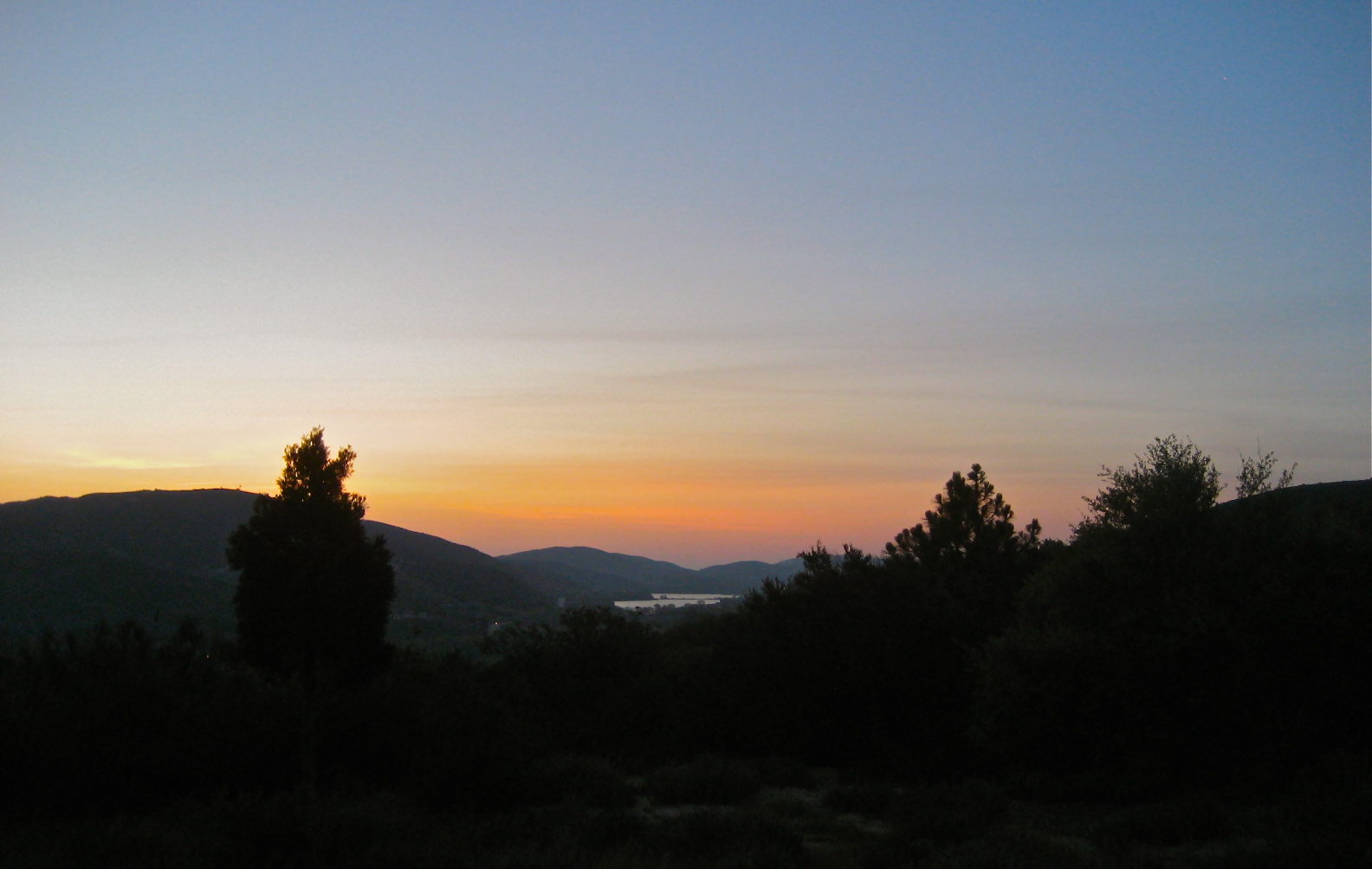


As the sun came up, I fell in with two other runners, Mike and Greg, and we climbed contentedly through the chaparral and scrub oak together. As usual in these kinds of situations, good company and conversation made the miles fly, and there looked to be nothing but a perfect day ahead. When the topic veered toward things like “the difference between the words further and farther,” and “correct usage of lie vs. lay,” I knew I was running with the right crowd. We vied for the title of biggest nerd, but as it turns out, Greg is a writer and teacher of the craft, and Mike is a research scientist at Cal State LA, so we were more or less deadlocked on that competition (although, I’m pretty sure Greg’s surfer-boy haircut keeps him out of the running, officially speaking).

Greg and Mike make the turn onto the PCT.


Mike and I take the hills easy. (Photo by Greg Hardesty)

Both men declared their interest in about a 10 hour finish, so I had hopes that we could run together through the day. As the trail evolved into a moderately downhill singletrack, Mike explained the intricacies of his research in proteins and manipulating amino acids. It was fascinating stuff, which I would explain to you here, but it’s top secret, (either that, or I’m incapable of explaining it accurately, but I’m pretty sure he said it was top secret).

After passing through AS#1 at different rates, Greg, Mike and I managed to re-group fairly quickly, and our posse continued on. I wondered if perhaps I was running too fast, as I’m often prone to do when I decide I want to stick with someone. I felt relaxed though, and I knew I would just have to take the day as it came, without stressing. I lost them after another break at AS#3, and wasn’t sure if they were ahead or behind. There was a solid climb out of the aid station, and I finally quit looking up and down the trail and simply settled in, focused on my uphill power-hike. Goodbye, boys, wherever you are. I hope your races go well!

Greg, Mike and the beautiful vistas of the Leona Divide.


This stretch of the course was an out and back to mile 32ish, and most of it was single track. I didn’t have any of the aid stations or any predicted splits written on my bottle since I had no real goal other than to get in some good training, and not further my injury. The aid stations were numbered, not named, so I’d figured even when I’m tired I can count to ten, right? Heh. I forgot about tracking mileage though, and I was essentially guessing about my mileage all day. How far had I run? I had no idea. I could have asked at the aid stations, but that seemed like cheating. This was all part of my laid back, SoCal mindset, right? No knowledge of miles meant no knowledge of pace, and that was just fine. I actually enjoyed not knowing, and I ran with my intended game plan of basing my pace on feel. I’m beginning to think this is the approach that works best for me.

There were a number of aid stations on this out and back stretch that we would also pass through on the return trip. I was grazing on strawberries and jelly beans at one of them when I said something (which, I’m sure, was terribly witty) to the volunteers behind the table. I looked up to see one of them smiling at me, and I just about passed out. This was certainly the most gorgeous man I had ever seen. I mean, I didn’t even realize they made human beings this attractive in real life. I began to think the instability of my legs had nothing to do with the day’s mileage, and I quickly looked away so I could gather my wits and get out of there. (As a side note to all race directors, you really shouldn’t have such good looking people at your aid stations; it’s quite challenging to run 50 miles and deal with surprise swooning!)

As I scampered quickly away, it occurred to me that most of the volunteers at this race were particularly attractive (though none came close to the grinning man at the strawberry table). I had noticed at check-in on Friday that everyone seemed so chic for a group of ultrarunners. At some point through this stretch we also hit an aid station with a 70’s theme, and this was when my theory was proven beyond debate. Even with afro-type wigs and ugly sunglasses, these guys and gals were nothing short of sexy. And I began to wonder – are all ultras in Southern California like this? It seems like such a stereotype, but is this place just teeming with beautiful people? I don’t know, but I’m thinking the matter certainly warrants some further investigation (in the form of more ultras down South, of course).

Jimmy Dean Freeman and his super 70's harem. It was thoroughly awesome to be greeted by this enthusiastic crew!


I was about 2 ½ miles from the turn-around when I saw Michelle Barton hauling ass toward me, not surprisingly with a commanding lead in the women’s race. I then embarked upon a long downhill on a dirt road in the slightly-too-warm-for-the-Tahoe-girl heat. With the opportunity to cheer the runners coming toward me,it might have been an enjoyable downhill if I hadn’t known that I would have to retrace every step back up.

When I was about 5-10 minutes from the aid station turn-around, I finally saw the rest of the women. Three women, including Kelly, were running close together and looking good. We cheered each other briefly, and I headed toward AS#6 at the bottom of the hill.

The day was starting to heat up, and I had a long, shadeless climb ahead of me. The volunteers were awesome, packing my bottles with ice, and handing me cups of icy liquid even though I’d requested nothing. I hated to waste the ice left in my cup, so I decided to take it with me on the climb by stashing it (sans cup) into the front of my sports bra. So cold, but so good! One helpful volunteer (who shall remain nameless) kindly offered to retrieve my “lost” ice for me. Gosh those guys are so darn nice! I had to laugh. Luckily it wasn’t the hottie from the earlier aid station, or I may have found myself accidentally saying yes, I need your help! Get that ice for me, would you?

As it turned out, the return trip wasn’t as bad as I’d expected. I’d run over 30 miles by this point, (although, naturally, I had no idea how far exactly) and now I was allowed to pick up the pace a little since I was feeling good. I surprised myself by running about 80% of that hill, and I almost enjoyed doing it. Before I knew it, the climb was over and I was back on the PCT!


The rest of the race was a blur of beautiful scenery, singletrack trail (with some challenging, head-on passing of the runners still headed out), more beautiful (and incredibly helpful!) volunteers, moderate climbs and descents, and a smile I couldn’t wipe off my face. My injured ankle wasn’t putting up any particularly loud protests, and I could tell by this point that I had paced myself well. Although I never had another glimpse of the women in front of me, I passed quite a few men all the way to the finish.

In this view of the Antelope Valley you can see the poppy fields in the distance. It looked like the desert was on fire!


Beautiful, runnable singletrack on the PCT!


With 7:30 on the watch I finally asked a volunteer what mile we were at. He said we had eight to go, and I found myself wondering if I could break nine hours. This was the first tangible goal I developed for this race, and since everything was feeling great, I knew without contemplation that I was going to go for it. I focused on technique to push both the ups and the downs, and had a blast doing it. I crossed the line in 8:45, 5th woman and 21st overall.

Totally happy with my time. Totally glad I skipped AR50.

RD Keira Henninger was on to hand out medals and congratulations at the finish. I happily drained a fresh bottle of chilled water and sat down in the shade knowing that this day was definitely a keeper. The trails were perfect and the abundance of flowers proved that this is clearly the best time of year for running this dry, shadeless and typically hot terrain. The weather was nearly perfect (mid to upper 70’s, as opposed to the 68 forecast earlier in the week, but nothing compared to the 90+ of Diablo the past two years) and I’d eaten and hydrated well. In fact, I couldn’t think of a single thing that went wrong on this day.

I cheered Greg and Mike, who both beat their sub-ten goals, while I happily refueled on homemade fajitas and Diet Coke. I had to call my family, who were picking me up, because I’d finished so much earlier than expected. But I’d say that’s a good thing.


Thanks so much to Keira and all the amazing volunteers. These folks were rock stars all day long. I’m thinking Leona Divide may have to become a new spring break tradition for me.

This is how I feel about the Leona Divide Trail Run!

Wednesday, April 14, 2010

Think More, Run Less

This past weekend was my first big race of the season, the American River 50. When I say “was,” I don’t just mean that the race itself is over. I mean that the idea of it being my first race of the season is also a thing of the past. I was a big, fat DNS at AR50.

My intention for this race was purely to use it as training, to get big miles in the month of April. I’d planned to follow it up with the Diablo Marathon the following weekend to ensure that I indeed wouldn’t take it too seriously. Unfortunately, Diablo got cancelled, and in searching for a replacement race, I came up with the Leona Divide 50. (What’s an additional 24 miles at this point, right?) Although plenty of people have questioned my plan for back-to-back 50’s, I have every confidence in my ability to take “races” as training runs, and I think it would have worked out beautifully. If I had been healthy. (And here’s where “unfortunately” starts to become my repetitive word of the day.)

As it turns out, I seem to be having a posterior tibial tendon issue. (I’d put in the actual, technical term where I have substituted the word “issue,” but I don’t think I could spell it.) To be honest, this is an issue that has plagued me for over two years, and no amount of time off seems to find any improvement. Unfortunately, the past few weeks have seen a marked increase on the pain scale, mostly likely due to increasing my weekly mileage fairly quickly.

It’s been enough to motivate me (at last!) to find an excellent physical therapist, and I’ve learned a whole lot about what is going on with my body. I’ll do my best to spare you the mind-numbing details, because the truth is, I don’t even enjoy trying to wrap my brain around it all. I’ll keep it to the basics so that we don’t all fall asleep here.

First, I love my physical therapist. He came recommended from a wise friend, so I guess it shouldn’t surprise me, but I have a really hard time trusting people in general, and especially when it comes to my running. Because, you see, I know everything. No one knows more than I, and woe to anyone who tries to tell me what to do. But this PT and I, we are on the exact same page. He has a very balanced approach, doesn’t think I’m crazy, and doesn’t necessarily think time off is always the answer. He makes sense out of a complicated picture, and he seems to approach things in much the same way that I do. Obviously he’s brilliant.

Second, I have learned that one of my legs is fully half an inch longer than the other, and this seems to be causing no small number of problems for me. The end result of all of this is that I am currently involved in the process of re-learning how to run. There’s a lot more to it than that, but that’s what it boils down to for me, and I hate it. I have to spend so much time thinking.

Thinking!

Running long distance, and trail running especially, has never been about thinking for me. It’s been the place where I have been the most free, the most at peace. In the past I have always felt in tune with my body while running, and it’s a part of the experience that I really enjoy. Lately though, we’re speaking through translators. It’s time now for me to learn the foreign language of my dysfunctional mechanics.

I know in the end, when I am healthy again, it will be worth it, but right now it’s tedious to think about every little detail of what I am doing when I run. It’s not a fun place to be when the thing that is normally a remedy for stress, becomes its main source. My love affair with running is definitely “on a break.”

So, while I’m grateful to be still running, I’ve taken many days off in an attempt to rest this inflamed tendon. The week before AR, I was out on a 30 mile trail run. At about mile 27, the complaints emanating from my tendon increased sharply in volume. It wasn’t a bad run, but it certainly caused me to question the wisdom of two 50-mile runs in a row, and the subsequent stress of this questioning made for some sleepless nights.

One lesson I learned (and will probably have to relearn many more times) is that it’s generally the indecision itself that causes the most stress. Once I decided running AR would constitute complete idiocy (although I’m fully capable of idiocy, I assure you), it was only a day before I got over the depression of my DNS and started to feel pretty good about the decision.

At this point, I’m looking at this weekend’s upcoming Leona Divide and feeling pretty excited about it. It’s a brand new race for me, and I haven’t run a new ultra in a few years. Unlike AR, it’s all on trail (much more my style), and it’s on the PCT. If you don’t know, I have a long-standing romance with the Pacific Crest Trail. Perhaps one day I’ll spend some time to wax poetic on that topic, but for now just know that I am thoroughly excited about the prospect of my first race on this trail. I’m still not taking a real taper (although the last few weeks of lower mileage have me more rested than I really should be), but without the AR50 teaser, this won’t be the “survival on dead legs” that I’d originally imagined. I’m going in with a conservative mindset, knowing I may have to back off if the tendon flares up, but also knowing that I’m pretty excited to get out there for an early season test of fitness.


Here are a few pictures from my last two weekends of running, and from yesterday’s powder day with Andrew. You can see how I have the best of both worlds in terms of getting both alpine adventures, and still finding dirt within a reasonable drive.


Newt!


Castle Peak


Climbing Donner Peak


Top of The Lake Run


Preparing to drop in


Wednesday, March 17, 2010

Down Memory Trail

This post was written back in January, which becomes apparent upon reading it. It was one of those pieces that seemed to lack enough purpose or clarity to merit publication at the time. I'm always telling my students that their writing must have a purpose, a theme, a main idea. If they don't know what that theme is, then how can they expect the reader to figure it out?

With the advent of the very spring-like weather this week, it felt appropriate to dust this one off and try to clean it up. I'm still not certain I've nailed the purpose to my satisfaction, but it feels worth sharing at least.


My feet hit the dirt in an easy stride, as I head toward the South end of Peters Canyon Regional Park. I bound over the railroad tie at the gap in the fence and head up through the eucalyptus trees. The pace feels gentle, and even the continuous incline doesn’t seem to increase my breathing. I follow the familiar, dry trail, winding upwards until my legs finally seem to feel the effort, and my heart and lungs respond accordingly. I simply can’t run slowly up this hill.

It’s the first day of a week’s visit in Orange County, and I’m planning out my daily runs with child-like anticipation, fueled by nearly six weeks of holiday excess and sloth instead of running. My legs are ready to get back to business.

I grew up running these streets and trails with the Foothill High School cross country team, and even during my racing days in college I returned to train here over school holidays. My legs know these routes better than my brain, and they turn instinctively onto the East Ridge View Trail, a rollercoaster of hills laid out across the crest of the ridge.

The park is comprised mostly of dry, hard-packed trails, winding their way through the openness of coastal sage scrub, offering rare moments of shade with small stands of eucalyptus trees. The creek running through the canyon below supports a riparian habitat and attracts a variety of birds. The dominant green hue gives testament to the recent rains, and I enjoy the relative lushness that is the privilege of late winter in these grounds where brown normally dominates the palette. New grass coats the dirt between shrubs, and green shoots foreshadow the golden poppies that will grace February and March.


At my current home in the small town of Truckee, high in California’s Sierra Nevada, the trails are deep in hibernation under the snow. It feels good to get some dirt under my shoes in January, and to run at sea level, where the oxygen is thick.

I ran through this canyon at 15 with my high school teammates. It was private property back then, and we had to duck more than one barbed-wire fence to get here. Resting on the edge of the neighborhood, it stretched out into a vast wilderness beyond. As the recklessness of youth often does, our disdain for the rules lent a heady sense of freedom and power. We flew through the canyon without caution, the only humans around, and felt a giddy kinship with the coyotes and mountain lions with whom we shared the trails. We reveled unknowingly in the sweet immortality of youth.


Now the park sits trapped between major roadways and housing developments packed with swimming pools and red tile roofs. But the trails still speak the same language--one I know fluently.

In contrast to my high school days, when we dove into the bushes at any sign of people for fear of being caught trespassing, the trails are now packed with hikers, runners and mountain bikers. Rather than feeling sad at the loss of the wilderness, as I am typically inclined to do, I find myself appreciating the number of people who are out enjoying the trails today.

Automatically, I push hard up each short, steep hill. In spite of my off-season lack of endurance, I decline to take this trail at a relaxed pace. That’s simply not how I run here, and my muscles know it. With the slow awakening that accompanies a long slumber, recognition dawns. We know this place, they say, this is where we run hard, where we search out our limits. And they take me, a passenger seemingly along for the ride, over each hill with a short, quick stride, arms pumping and lungs heaving. It feels good. It feels familiar.

The following day I am headed out to Colonel Barber Park to meet my sister and her two young boys. I pull out of the driveway in my dad’s ’68 VW Bug, and this, too, feels familiar. I hate to even call this car “my dad’s.” This was my car for the first 5 years of my driving life. It still feels like mine, and as on the previous day’s run, my body agrees. Muscle memory kicks in as my heel naturally shifts over, toes still on the brake, to tap the gas pedal so the cold engine won’t die. I need the full foot to brake at the first corner, so it dies anyway, but it’s downhill, and automatically, I roll through the quiet intersection without stopping and pop the clutch, like so many times before.

Cruising down Barranca Parkway, I inhale with quiet pleasure, enjoying the warm January air of Southern California. I flip open the front triangle windows to adjust the wind directly at my face. As my hair blows back, the breeze carries with it the freedom of a teenager with her first car. I am sixteen, and I can go anywhere I want. I briefly contemplate heading down to Balboa. I could cruise the peninsula for hot surfer boys, music up and windows down. But reality snaps me back from those years to my playdate with the toddler set, with its promise of smiles and laughter, and I happily pull into the park a half an hour early to meet my sister.

Unsure of what to do with this nugget of free time, I automatically look at the endless, grassy playing fields with longing. I’m dressed for a run, except for the flip flops, and I silently curse myself for not wearing running shoes. It’s only after a few minutes of staring at the vast expanse of empty soccer and baseball fields that the patently obviously finally occurs to me: With so much well-groomed greenery, who needs shoes? I drop my jacket and kick off my flips at first base, along with any remaining cares, and trot off through the grass.

This particular park is new since my migration from the South, and I’ve never run here before. My feet explore the terrain with that sense of freedom gifted by the absence of any sort of plan. I don’t have an intended number of miles to run, nor a certain pace to hold. I don’t even have a direction, as I’m prancing aimlessly around the sport fields. I decide to make it an interval workout, and alternate my speed: sprint, jog, sprint, jog. I don’t know how long each period lasts – either in time or distance. I just enjoy the racing of my heart, the spring of my toes in the grass, the sweat between my shoulder blades as it trickles down my back.

“Auntie Gretchen! Auntie Gretchen!” calls the five-year-old voice from the playground. Like a school bell at recess, that’s my signal for the end of the workout. I round first base to collect my shoes and head off to push swings and chase kids through the sand.

The following day I talk my mom into going to Irvine Park. She’ll walk; I’ll run. I don’t usually get as many miles here, or as much dirt, as I do at Peter’s Canyon. Still, this park holds even more memories.

One of these memories revisits every time I run the paved hill on the South side of the park. It was here, when I was 19, that I had my single encounter with a mountain lion in the wild. As I neared the crest of the hill, the lion emerged from the bushes at the side of the trail 30 or 40 yards in front of me. She stepped casually into the trail, and I immediately halted the forward progress of my run. Having grown up in the area, I was well-educated in the behavior of the lion and knew I didn’t want to trigger its prey instinct. In spite of a disconcerting lack of fear, I still had immense respect for the animal.

She paused to look at me, and the moment of mutual curiosity makes me smile when I think of it now. I was so naive. But truly, it’s better that way. I felt safe enough because I thought I knew that one should act aggressively toward the mountain lion in the event of an attack. What I didn’t realize was that my own choices and behavior likely meant nothing at that moment. All of the power lay with the lion. And again, I am reminded of the infallibility of youth.

On that day, after the lion continued across the trail into the bushes on the other side, I merely continued (at a walk) down the trail. When I reached the point where she had disappeared into the bushes, I looked up the hill to find her sitting there, calmly looking back at me. What would most likely be a heart-racing, fearful encounter at this point in my life, was then merely exciting and beautiful. I have that lion to thank not only for choosing to give me nothing more than a few casual glances, but also for giving me a powerful memory that’s often been cause for reflection.

Irvine Park was also the site of every one of my home cross country meets in high school, and I can’t run on a section of the course without recalling the feel of that particular point in a race. The specificity of those memories has faded with time; I can no longer recall specific races, and I no longer race rivals of the past as I flee down the trails. The mountain lion, however—I can see her face clearly every time I am there.

These are the thoughts that amble through my mind as I let loose on the dirt downhill that comes in the first mile of the old x-c course. The sunshine of the previous day has given way to a warm drizzle, and I wipe wet hair from my face as I cruise through the section my coach used to call “through the oaks.” On the far side of the creek bed I catch up with my mom and opt to walk the last mile with her. It only makes four miles for the day, but mileage is still trivial in January. Walks with Mom are precious and few.

I’ve heard it said that in life, we are our current age, and we are also every age we’ve ever been leading up to it. This makes perfect sense to me. I am 36, but I am also 12 and 15 and 19 and 26. On the trails of Orange County, more than anywhere, I am a teenager. I’m not the confused, angst-ridden teenager that I may once have been, but I still recall the joys, some of the challenges, and the simplicity that often accompanies youth. When I run here, I can let go of goals and needs, and yet still run hard. Somehow, I can tap into every type of runner I’ve ever been—5K road runner, miler, trail runner, ultra-runner—and be all of them at once, while defined by none. If a place can have a memory, the trails of Orange County remember exactly who I am.


Monday, March 15, 2010

Cool Pictures

It was a trail runner's weekend, and it was just what I'd been craving.

On Saturday, Diana and I got up way too early for a non-race day and headed down the the hill through the freshly fallen snow for a long run on dirt. We managed to get in a relatively mud-free 21 miles in Auburn, enjoying the empty trails, the serenity of the lifting fog and the beautiful north fork of the American River.


Diana navigates the foggy oaks.


A vulture spreads its wings.


Foresthill bridge


At 11:00 we headed over to volunteer and cheer at the Way To Cool 50K. Here are some photos from the Highway 49 aid station.


Max King


Geoff Roes, still in third even after a rumored wrong turn


Victor Ballesteros


Rod Bien


Joelle Vaught


Joe Palubeski, who totally looks like he's giving the volunteers the business, doesn't he? Hee hee.


Bev Anderson-Abbs gets some quick aid.


Mark Tanaka


Darcy Africa


Jenny Capel. She had a woman right on her heels who totally had a target on Jenny's back, but of course she held her off. Jenny's a bad ass!


Mark Gilligan


Rick Gaston flashes the volunteers that charming smile.

Sunday, Betsy and I headed over to the hills east of Reno to explore some new trails. On this day, we had a much needed late start. We had no idea where we were going, and just spent the afternoon navigating new terrain, laughing, sharing life stories, and enjoying the sunshine.

These are the things that will get me through to next weekend.

Thursday, March 11, 2010

The Great Ski Race 2010

Last Sunday, I joined over 1,000 other enthusiastic skiers for a North Tahoe tradition: The Great Ski Race. This 30K course travels from Tahoe City to Truckee, and provides a venue for everyone from elite racers to beer-drinking party-goers. My day involved reconnecting with friends, heart-pumping hill climbing, cautious descents, and, of course, a few good crashes.


View of the starting area from wave 4

The forecast had been for cloudy skies and a chance of mixed rain and snow. Not exactly good news for a fair-weather skate-skier like me. What we got was yet another blue-bird Tahoe day. It was cold enough at the start for some fast conditions, but warmed up to make things a little mushy by the end. (I guess the key here is to ski faster and you'll get good conditions the whole way!)

Susie is ready to start!

In addition to attracting talented skiers from all over the country, this race is one of those community events where I feel like I see every local I know: neighbors, friends, co-workers, students. It makes for an enjoyable day, and helps me remember that my goal here is fun, not competition.

The race starts in six different waves. You're assigned to a wave based on your previous finishing time at this race. (If you're a first timer, you have to start in the back.) The fast kids take off first, and each wave has progressively slower skiers until you get to what they call the "party wave." I ended up in my standard wave 4 - somewhere between the real racers and the partiers.

Racers start with their skis in the groomed tracks, and when that wave starts it's double-polling only (no skating) until you get a couple hundred yards out where the tracks end. Then, it's skate like mad through the wide stretch to try to get ahead of as many people as possible before the inevitable bottle-neck that occurs almost immediately. Since I always get my butt kicked at this race I don't take it too seriously. Thus, I always find this mayhem at the start to be terribly fun!

Soup station #1, at the top of the pass

It's crazy to me that the race never really seems to thin out as much as I'd like. For the entire first 10K it seems like I'm knocking skis with people. This isn't a big deal, until you get a klutz like me tangling you up enough to cause a crash.

Aside from the glaring disadvantage that I have ghastly skating technique, this course works well for me mentally. The first 10K is all uphill, which is, of course, where I excel. I pass folks like mad all the way up. By the time I reach the top, all the hard stuff is over with, and I still get 20K of trail to enjoy.

The next 10K is downhill, and the last 10K is rolling. This, of course, is where everyone I passed on the way up kicks my spineless, fraidy-cat, I-suck-at-downhills booty. But the scenery is awesome!

Here's an extremely short clip of the trail. I had a rather tenuous grip on my camera, and knew I was risking a fall by trying to hold a camera and ski pole at the same time, so the footage is sub-par to say the least, but it gives you a little idea of the trail, anyway.


A race like this is a perfect way for me to start the season. It's a killer workout, and a huge exercise in humility. For twenty kilometers I am passed by little girls and old men alike. I was passed at about the 15K mark by a former colleague of mine who is a great skier. I couldn't figure out why she was even behind me in the first place, until I realized she was just pacing her daughter. And I'm not sure, but based on size, her daughter couldn't have been much older that eight. They beat me by 14 minutes.

View on the descent

I had a few good crashes on some of the steeper downhills, but nothing too painful. I actually couldn't help but laugh as I looked both up and down the trail to see skiers everywhere, sprawled pell-mell about the trail, those who remained upright trying to navigate the human obstacle course. Such good fun!

The finish of the race consists of a portion that I like to call "The Ice Luge." After your muscles are quivering from the exhaustion of navigating 30K, the skier is required to negotiate a series of narrow, steep, hairpin turns. If you're like me, about 500 skiers have already come through to scrape the top layers of snow off, and you're left with a scooped-out track of ice. Slowing down? Forget about it. It's so terrifying for me that I always find myself laughing through the whole thing.


Way back up there at the top is the end of the "Ice Luge" section. Notice skiers are still braking hard toward the finish line.

Once you survive that, you pop out onto the wider, downhill stretch across the finish line. This part is much easier because it's wide enough to make turns and slow down. Of course, many skiers think they're home-free and carelessly get up enough speed for an exciting crash. Spectators always have a good time at the finish of this event!


Many skiers come across the line with their feet in the air. Oops.


Thanks to Tahoe Nordic SAR for putting on another great year at The Great Race!

Saturday, March 06, 2010

Iditarod 2010!

It's an exciting day in Alaska, and people from all over the world are watching as 71 mushers and over 850 dogs take to the trail for the 38th Iditarod. For lovers of endurance events, this one really is the ultimate. Dogsled teams take between 10 and 14 days to cover 1,100 miles between Anchorage and Nome, traveling across frozen rivers and high mountain passes, through the interior of Alaska, and along the coast. The race, just like its home state, is one of epic proportions.

For my own brief stint running dogs, I spent a season working as a dog handler for a musher in northern Minnesota. It was an amazing winter and fulfilled most of the dreams that had brought me from southern California to the north woods. If you've never driven a dog team across a frozen lake, I highly recommend you put it on your bucket list. It's difficult to describe the experience: the excitement of the dogs born to pull, the frozen air flying past your cheeks and stinging your eyes as you lean into a turn, your lead dog so far around the bend that you can't even see her anymore. It's magic.

During that winter, I read every book I could get my hands on about dogsledding, and the musher's library was extensive on the subject. If you think I didn't dream of running the Iditarod myself one day, then you clearly don't know me very well. I still love the idea of it, but I learned enough during that winter to realize that running the Iditarod requires not only a lifestyle commitment to prepare, but that the race itself presents some challenges I don't think I'm equipped to handle (sleep-deprivation being the first to come to mind).

I still enjoy spectating for this one though, and the race website offers more information than I can really absorb. I'm also subjecting my students to a cross-curricular Iditarod unit this year. (Once I learned how much they all love dogs, I couldn't resist.) We'll be learning a little history, following the mushers online and running some statistics during math, and reading Woodsong, Gary Paulson's memoir for middle-grade readers about running the Iditarod. (If you're interested, Paulson is a fabulous writer, and his version of the book for adults is called Winterdance.)

Here's a little teaser video, offering a glimpse of some of the excitement of the race. It's short (about a minute) and put together by Dallas Seavey's sponsor, but I like it because it has some great footage and appropriate, heart-pounding music.


Here's one that's a bit longer, and was sort of an introduction to the 2008 race. The musher's it names are from that year's race, but the Iditarod tends to feature a field of extremely experienced mushers, so it isn't surprising that you'll find most of those same names on this year's start list.


Best of luck to all the mushers and dogs out there over the next two weeks!