There are probably many reasons to run the Napa Valley Marathon, but two especially stand out to me. One: The weather. Sundress and flip flops the first week of March are highly appreciated. Second: The wine. It’s everywhere.
I picked up my bib number at the Marriott on Saturday and walked into the expansive courtyard to enjoy the sunshine when I spotted the wine tasting area. Shouldn’t all races have wine tasting at registration? It wasn’t until I was sitting on a sofa with a glass of Clos Du Val Cabernet in my hand, face tilted up toward the sun, soaking up rays on my shoulders, that I remembered I’d given up alcohol for lent. Aw crap!
I immediately decided this minor transgression didn’t count because,
A) I had actually forgotten, so it was completely innocent. (Besides, it was just a taste!) And
B)I’m pretty sure it’s a sin to go to Napa without drinking wine.
My conscience safely cleared, I thoroughly enjoyed the weather, the wine, and chatting with the other runners relaxing in the courtyard with me.
The idea of actually running the race was less appealing, and this idea occurred to me Saturday night when I crashed at a hotel in Fairfield and wondered what the hell I was doing there. The Napa Valley Marathon was to be my first “real” race of the season. If you read my season preview, you know I’d originally had high hopes for this race. (I was thinking 3:15, which would have been an 11-minute PR.) You’ll also recall that my health, and as a result, my training, fell apart in February. I now had fairly dismal expectations for Napa.
The icing on the pity party cake came when I started my period. It brought with it painful cramping, an aching back, and a flood of negative thoughts. Thoughts like What the hell is the point of a road marathon anyway if you can’t even run fast? And I won’t bother with my camera because I don’t even want to write a race report about this dumb race. Also, How am I going to make it 4 hours without changing my f**king tampon? And with that brilliant mindset, I set the alarm for 4:00 A.M. and went to bed.
I knew things would all be fine once I started running. Running fixes nearly every bad mood. I only wished I had a clue how to pace myself. Two weeks earlier, near the end of my illness, I’d run a 5K in 23:00 and it had hurt. That kind of pace should not hurt for 3 miles, so I was a little worried. I wasn’t sick anymore, but I knew the illness had taken a toll. I promised myself I wouldn’t run faster than 8:00 pace for the first ten miles.
So of course I went out at 7:40 pace.
I wasn’t sure if I was being stupid, but it felt pretty decent. We ran through mist covered vineyards as the sun rose gently, and although there were a couple of small rollers, the terrain was basically flat. I smiled at a few familiar faces and gloried in the freedom of running in just shorts and a tank top.
I hit the half marathon in exactly 1:40. I briefly wondered if I had it in me to run even splits. I would be extremely happy with 3:20. That seemed ridiculous though. Merely a dream.
The advantage of being an ultrarunner in a marathon is that you nearly always feel like you don’t have far to go. With only 13 miles left, I decided it was time to pick up the pace. The average pace on my Garmin said 7:39. I wasn’t tracking splits, but I did work on making that “average pace” number gradually shrink.
The miles seemed to fly by. Every time I came to another mile marker I’d think, Really? Already? They were just coming so fast.
Now I was steadily passing people who’d passed me in the first five miles. By the time I hit mile 19, I’d dropped my average pace to 7:30. This was good, I knew, and I smiled. I wanted to shrink that number even more.
By mile 21 though, I was still holding 7:30, and I could see I would have to fight for it. By mile 22 I started doing the math on the last 4 miles at 8:00 pace. I was getting tight, and with tightness comes worry.
A wonderful thing happened then. A woman passed me who was running strong, and I tucked in behind her. I held on for dear life. We ran the next mile in 7:15 and it killed me to stay with her. She was one of those tough-cheerleader types, which was exactly what I needed right then. I knew I had a chance at going under 3:20, and I wanted it, I really did. I also hurt like hell and wanted to stop.
Cheerleader woman was awesome and kept encouraging me to stay strong. I love it when people work together like that and help each other at the end of a race. It’s just so cool.
I worked desperately to stay with her for another half mile, knowing once I let her go that I could fade badly. She moved ahead, but miraculously, I never fully lost sight of her. My form fell apart and I felt like I was running nine or ten minute pace, but my average pace only dropped to 7:31.
It was one of those big smile finishes – the kind where you are so stoked you just start laughing. That was me, grinning and laughing and falling across the line in 3:19:08.
I could not have asked for anything more from this race. I can’t figure out how I pulled off a 7-minute PR with such a disastrous February behind me. Truthfully though, I don’t really care. I’m sore as can be and completely stoked. Racing season has begun!

Tuesday, March 06, 2012


Thursday, February 23, 2012
Epic Adventures Part III: In Search of the Gobi Bear

Whenever I wonder where I get my affinity for adventure, I remind myself, with a knowing, inner smile, of one of my closest family members: my father. Adventurousness could be a genetic trait, but in my case, it could also be that I was taught to love all this craziness. It wasn’t explicitly taught of course, as both my parents will tell you that I’m often prone to follow the opposite of any actual instructions. It was taught, as most things are in this world, by example.
Slideshows
of my father’s journeys from my younger years still remain vivid in my mind –
scuba diving trips mostly, to places like the Galapagos Islands, the Red Sea,
and the Great Barrier Reef. Photos of brightly colored birds, coral reefs
teeming with life, and all manner of undersea creatures still seem like the
stuff of magical lands to me. Our planet still seems like an exciting place to
explore.
To the
casual observer, my father and I might appear to be opposites. It’s true, we
have some differences. I like to characterize them by saying that he gets his
news from the Wall Street Journal, and I get mine from National Public Radio.
But the truth is, he still turns on NPR in the mornings (even if just to gripe
about their liberal bias), and I’ve recently enjoyed the benefits of following
@WSJ on Twitter. My Christmas gifts to him are nearly always non-fiction books,
hopefully on topics that inspire good conversations between us. I shoot for
books where we have common interests – endurance sports, adventure, sometimes
history. Family visits usually find an opportunity
for us to go on a long bike ride or a short run together, (except he would
probably characterize them as a short bike ride and a long run).
So when, in
the winter of 1999, my father suggested he and I take a big trip together, it
made perfect sense to me. He’d just finished riding his mountain bike across
Siberia the previous summer, and was eager to return to the remote areas of the
Asian continent. One of us, I can’t recall which, had recently read about the
Gobi Bear – a sub-species of the Brown Bear and the world’s only desert bear.
Located in the vast desert of southern Mongolia, this rarely seen bear was on
the verge of extinction. When discussing the idea of an expedition to view it
in the wild, both of our eyes widened in excitement. We had to try!
The idea
that a 50-something doctor from Orange County would be setting off to explore
the outer reaches of the Gobi desert with his 25-year-old, nature-girl,
feminist daughter may sound odd at first. As it turns out though, we were the only
two in our family who could see that traveling by jeep and camel across a
desert of the most sparsely populated country in the world in search of a
rarely seen bear had the makings of a dream vacation.
The month of
May was set aside for the adventure, and soon we were off, with quick stops to
Tokyo and Beijing, before arriving in Mongolia’s capital, Ulaanbaatar. I had
already spent several years working as a wilderness guide at that point in my
life, but the challenges of world travel were largely unknown to me, so I
considered it quite an adventure just getting to Mongolia.
 |
| Beijing's Forbidden City |


 |
| A soldier at the Forbidden City |
We had a
contact in Ulaanbaatar named Timur who helped us arrange the logistics of
transportation, food and a guide who would know where to look for the bear.
While in the city, we visited a museum and a Buddhist Temple, and Timur
explained some of the recent changes in Mongolia since the fall of Communism in
the early 90’s. The country had become a parliamentary democracy with a
free-market economy, which had increased the prosperity of the people and
resulted in a baby-boom of sorts. It also gave way to a resurgence of the
country’s majority religion, Tibetan Buddhism, which had been suppressed under
the Communists. There was interest from foreign businesses in mining
exploration, and their tiny tourism industry was expanding. It was a hopeful
time in Mongolia.
 |
| Buddhist Temple in Ulaanbaatar |
 |
| Our plane at the airstrip in Gov-Altay |
A short
flight in a propeller plane brought us to Gov-Altay, on the edge of the Gobi
Desert. We still had several days of driving to reach the tiny desert outpost
of Bayan Tooroi where we would pick up our guide and finally set out in search
of the bear. We piled into an ancient-looking Russian-made jeep with a driver
who, unbeknownst to us, was completely unfamiliar with this half of the
country, and headed south.
In researching
our trip, we’d had difficulty finding a good map of Mongolia. The one my father
finally did acquire was rife with mistakes, but still helpful since our driver
had no maps. We quickly learned that no one navigates by map in Mongolia,
largely because once you’re 100 miles out of Ulaanbaatar, there aren’t any
roads. (Also, there aren’t any maps.)
Here’s how
navigation works:
1)
Find
a jeep track that heads in the general direction you want to go.
2)
When
you see a shepherd across the steppe with his flock, drive up and ask him
directions. (It helps if your driver speaks Mongolian, not just Russian. We
learned this the hard way.)
3)
Follow
the direction indicated until you see another shepherd.
4)
Repeat
process.
After a day
of this, we spotted a line of power poles heading south into the desert and followed them,
reasoning that our destination was the only inhabited area with power, so that
must be were the electricity was going. Navigation by power lines!
 |
| Fixing the jeep. The russian made jeeps popular in Mongolia were fairly simple, which was good since on-the-go repairs were frequently necessary. |
As we
bounced slowly down the rough track, I had to put my hand on the ceiling of the
jeep in order to prevent my head from cracking into it. These jeep tracks
couldn’t be any better than simply driving cross country, I reasoned. But when
we inadvertently veered onto a track heading away from the power lines, I was
proved quite wrong in this notion.
Once the error was discovered, we turned off
the track to cut cross-country directly back to the power line guide posts, and
I learned the true meaning of jeep-crawling. The vehicle became a giant washing
machine and we the dirty laundry tossing about inside. After ten hours of
already rough driving, this wasn’t the ride my stomach had been looking for,
and I couldn’t imagine how the driver was keeping his foot on the gas pedal
with the jeep lurching about so much. Perhaps that was a contributing factor in
the lurching.
 |
| Our driver and his jeep. He was obsessed with keeping the dust off and would wipe it down at every opportunity, which seemed like a fruitless effort to me. |
We rejoined the power line track right at dusk, and by comparison the ride suddenly felt incredibly smooth. Finally, I saw the tiny lights of Bayan Tooroi! It had been a long day of driving – not really my favorite activity. We were probably 30 minutes from our destination when the headlights went out on the jeep, and it turns out that there is not much darker than the Mongolian desert at night. My heart sank; there was no way we could drive without lights. But one thing you learn when the conveniences of civilization are always a far off thought: improvisation. Our driver turned on the emergency flashers and we found our way across the desert with the aid of a red strobe. Brilliant!
The next day
I had a chance to explore the small village on my own. This turned out to be
one of the most memorable experiences of the trip for me. I was wandering among
the gers (yurts) admiring how each identical home distinguished itself with a
decorated door. Gers are the traditional dwelling of the nomadic people of
Mongolia, and they still house the vast majority of the population. Round in
shape, they are composed simply of a lightweight wooden frame covered in hand-felted wool. They are quite structurally sound to keep out the harsh Mongolian
weather, yet easy to disassemble, transport, and reassemble, allowing nomads to
follow the herds of animals.


 |
| Bayan Tooroi |


 |
| Russian made motor bikes were also a very popular form of transportation. Also frequently in need of repair. |
As I
photographed the doors, I attracted a growing flock of children and turned my
attention toward them. It should be noted that tall, fair-skinned women were an
anomaly in the Gobi desert, and they were clearly as curious about me as I was about
them. I held up my camera, and they gamely posed for pictures. Sharing no
language, we communicated surprisingly well through gestures and smiles.


 |
| Children of Bayan Tooroi |
Eventually
someone’s mother showed up and invited me, with an ushering smile, into her
ger. I followed, along with my dozen giggling companions. Her ger had rugs for
flooring, and we sat in a group on them as she handed me something I thought of
as tea. It tasted bitter, and actually rather nauseating, but I was completely
thrilled to be there and smiled graciously as I sipped. I felt so honored to be
welcomed into their home, and the fact that we couldn’t actually speak to each
other seemed insignificant. Even though we came from incredibly different
lifestyles and backgrounds, it was a moment that made me feel that as human beings,
we are all so much more alike than we are different.
My father showed up to join the party, and he had brought his Polaroid camera.
We took pictures of each kid to give to them. They were excited about the
Polaroids, and we enjoyed having something to share.
 |
| Dad snaps Polaroids of the kids. |
Bayan Tooroi
was also where we were to meet our guide, Choijin. A small man, seemingly far along in
years, he was a naturalist paid by the government to study the bears and other
wildlife, and he was the person with by far the most knowledge on where to spot
animals in this vast, sparse landscape.
(In fact,
years later I was watching the BBC documentary, Planet Earth, and I was thrilled
to see Choijin leading
the BBC team through the Gobi on a quest for wild camels. I love this YouTube clip from Planet Earth because it shows exactly the same Mongolia we experienced.)
Preparing
for the desert meant obtaining food, among other things, and food in Mongolia
is mutton. With the help of our guide we negotiated the purchase of a sheep
from a local herdsman and I watched, fascinated, as they slaughtered and prepared
the meat for us. Our small group wouldn’t be able to eat all of it before it
would rot in the desert heat, so we gave some of it away as gifts.
 |
| Selecting dinner (and breakfast and lunch) from the flock. |
 |
| I was first handed the reigns of this camel with zero instruction. Not how to make it stand up or how to steer it. Not even how to get on. Because what idiot doesn't know how to ride a camel? |
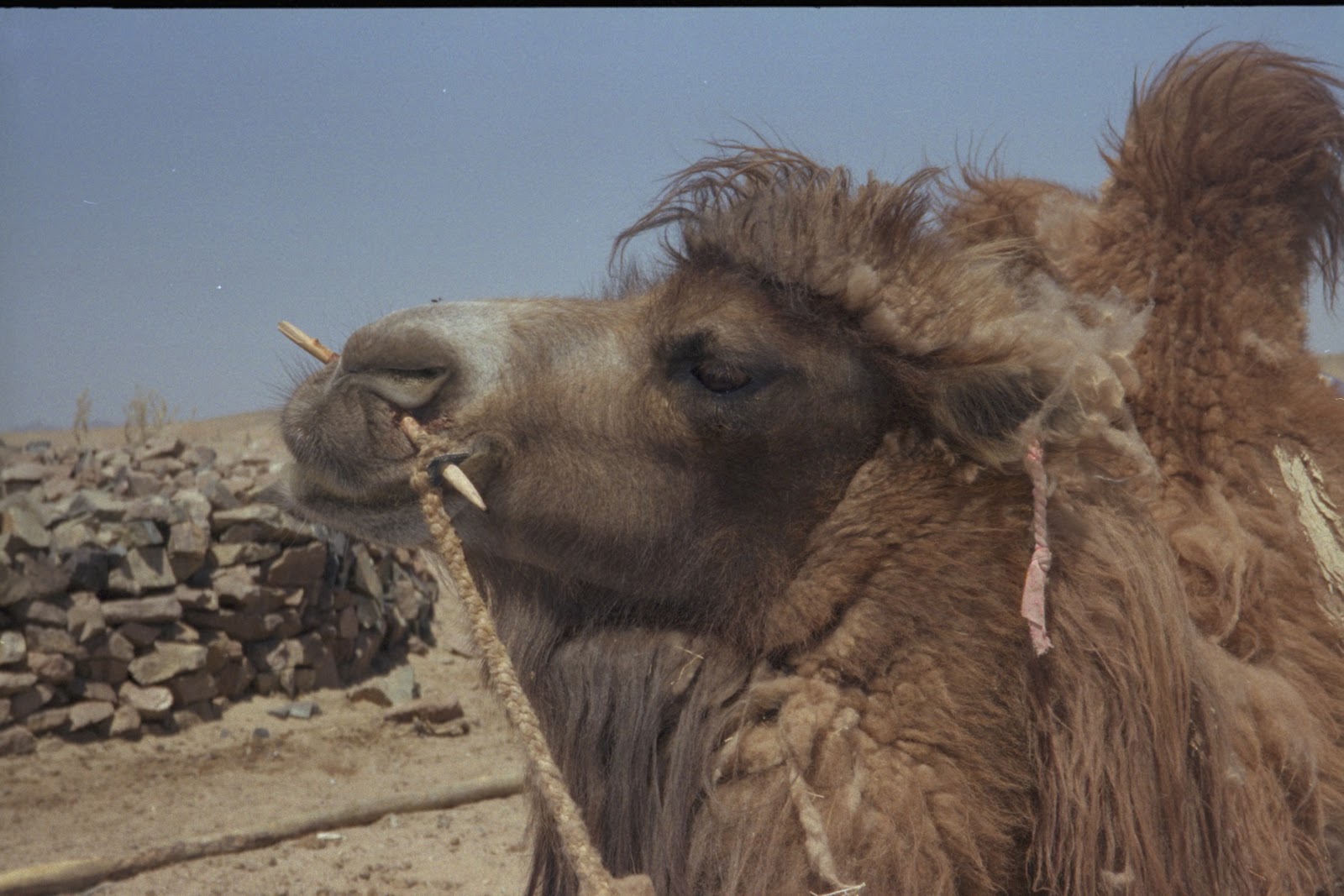 |
| My camel was totally punk rock. |
After we had
gathered and organized the necessary supplies, we set off for a two week
exploration of the desert. On our very first morning, around dawn, we had our
first sighting of the Gobi bear. Wow! I thought our guide was amazing! It turns
out that in a desert there are very few food and water sources. Ah, yes. The
locations where it is likely to see a large animal such as a bear are actually
fairly limited, and thus somewhat predictable. Still, I was impressed with our
early success, and excited for the rest of the trip.
We returned
to the same site that evening and lay quietly in wait for the bear to return.
When he did, we had our best views yet. Completely lacking in wildlife
photography experience, I didn’t have the right camera equipment for such low
light conditions. All my bear pictures could be summed-up as “fuzzy brown dots.”
It really didn’t matter though. From our perch up on a rocky outcropping, we
watched with giddy enthusiasm as he poked around the small valley until it was
too dark to see.

The Gobi
bear is quite small compared with brown bears of North America. This is a
result of living in the harsh desert environment. Although I have a great deal
of respect for all bears as wild animals, I couldn’t help thinking of our bear
as “cute.” He just was.
The
remainder of our desert explorations were unsuccessful for bear sightings. I
learned a lot about hunting, even though we shot with cameras and not guns. I
learned that there is a lot of sitting and waiting which is, not surprisingly,
something that neither my father nor I am very good at. We did see gazelles, wild
camels, and Argali sheep. The sheep especially were beautiful. The rams have
the largest horns in the world which, sadly, makes them a target for trophy
hunters.
 |
| This is the most awesomest picture of my dad ever! |
With our early success at spotting the bear, my expectations had been raised, and it was tough to spend the rest of our days with no other sightings. We had known from the outset though, that we could potentially come all that way and not see a bear at all, so in truth, we had been quite lucky.
 |
| These soldiers were living in a cave guarding the Mongolia/China border. It kind of freaked me out to see men with machine guns in the middle of nowhere. |
 |
| Choijin and me. |
Before departing the desert region, we made a trek to several sites near Bayan Tooroi. One of these was an area of sacred pools among some fascinating rock formations. I imagined that when the water was flowing it was even more beautiful, and it wasn’t difficult to understand why such a site would be considered sacred in that endless, arid land.
 |
| Rock Formations |
 |
| Relaxing among the sacred pools. |
The journey
back from the outer reaches of the desert, to the relative civilization of
Ulaanbaatar, turned out to be the biggest adventure of the trip. We made it to
Gov-Altay with relative ease, but a storm had moved in which caused some issues
with our flight. The tiny airport did not have appropriate communications, and
the plane was not rated for instrument flight. Or perhaps it was the pilot that
wasn’t rated, but regardless, the plane was grounded until visibility improved.
We spent a
day in wait, and this allowed us to do a bit of exploration around Gov-Altay.
Eventually though, we realized such things as:
A) If we wanted
to make our flight from Ulaanbaatar, we might have to drive, and
B) If we
were going to drive we had to get on our way. It would be a three day trek via
jeep.
It was
during this epically long drive that my father finally admitted I’d given him
appropriate advice on what to pack for the trip. He’d laughed that I had him
bring a fleece jacket and pants, as well as rain gear, to a desert. As we drove
through the mountainous region of the country, the temperature dropped and the
same storm that had stranded our plane now coated the landscape with snow. We
were both wearing everything we had with us.
 |
| Hearty camels in Mongolian weather. |

Along with an immense, unending barrage of bouncing around the inside of the jeep, a few memories stand out vividly from this crazy drive:
- We encountered another jeep headed in roughly the same direction and our two drivers decided to stick together for safety. This scared me because only then did I realize that our driver thought the journey was dangerous.
- We saw a wolf in the middle of the night, and the other jeep pulled over to shoot at it, prompting me to scream, “NO! Don’t shoot the wolf!” Talk about a culture-clash of perspectives. My father and I still laugh over this one. I felt relieved that their shots missed, but at the same time a little guilty about my relief. The wolf probably would have meant a lot to them.
- We reached a river crossing which was so deep I was positive we should not attempt it. It was dark and snowing and we were in the middle of Mongolia and our driver wanted to go for it. I was fairly certain the water would rush in the doors and we might die. But what could we do? I remember turning to my father and saying, “Mom would NOT like it if she knew what we were doing right now!” We both erupted in laughter.
- At the top of a snowy mountain pass in the dark we got out of the jeep in front of a large pile of rocks adorned with prayer flags marking the summit. We joined the people from the other jeep in a local ritual of circling the giant summit cairn three times, adding our own rock to the pile, and asking the gods to bless our journey and keep us safe. I enjoyed participating in a local custom, but again, it made me nervous that even the locals thought this trip was dangerous.
- The driver had one tape in the car. It was traditional Mongolian music performed by a popular artist. I would conservatively estimate that we listened to it no fewer than 47 times. Eventually, I began to sing along. In Mongolian. The driver loved this and pretty soon we were all singing together.
 |
| Stopping at the pass to ensure our safe travel. |

Eventually, we made it back to Ulaanbaatar quite exhausted, but in time for our flight home. My experience in Mongolia wasn’t all about seeing the Gobi bear, although that was certainly an exciting bonus. A lot of it was simply about foreign travel and experiencing the kindness and hospitality of people on the other side of the planet. I saw a country living very much the way it had for thousands of years, yet with a western influence that made me more than a little uncomfortable. Gov-Altay, for example, was a big enough town to receive a lot of imported products – disposable things with disposable packaging. Yet, they had no real garbage system, so people were in the habit of merely throwing things out the window, into the wind. This made my heart crumple, as I could only see western influence destroying their beautiful country with its garbage. In Ulaanbaatar this was evidenced by garbage blowing around the streets, trapped up against chain link fences that prevented it from escaping into the broad landscape. My dad thought a bigger problem was their expanding population and lack of infrastructure. Even in Gov-Altay most people lived in gers which had no running water and only pit toilets. I wondered deeply what the future would bring for the people of Mongolia.
 |
| Gobi Sunset |
Ultimately,
for me, this trip was an adventure that influenced my thinking about my own
life. I saw a rare, near-extinct bear, countless friendly smiles, and a country
in a place of hope yet tempered with uncertainty. I spent an unforgettable
month connecting with a new culture, facing unexpected challenges, and sharing
it all with my dad.
He and I
have continued searching out new adventures. He still rides his bike, whether it’s a double
century or simply to work and back. I seem to run farther and crazier with each
passing year. But we still manage to get together for adventures of the less
epic type – day hikes in Yosemite or mountain biking around Tahoe. The older I
get, the more I see myself in him. Or perhaps it’s that I see him in me?
Regardless, I know I’m lucky that I have
a dad who gave me the gift of adventurousness and wanted to share it with me so
many years ago in Mongolia, where we found much more than just the Gobi bear.
 |
Thursday, February 16, 2012
2012 Season Preview
 |
| 2011 Highlight: The Placer High Track with Jamie |
After last year, I promised myself I would do two things
this year: race less and not run a 100-miler.
Um, … yeah.
My reasoning was that I needed a break from the stress of
running a 100-miler. I know some people run these things all the time –
multiple 100-milers in a year. For me,
that kind of training takes a huge amount of mental focus, not to mention time.
I thought I was ready to be a bit more of a well-rounded athlete for a while –
get back to some rock climbing and some mountain biking.
My motivation for racing less stemmed primarily from the
fact that I completely went over my racing budget last year.
And then I got into Hardrock.
So, I figured with the “no hundo” promise out the window, I
may as well give up on “less racing,” too. Sometimes you just have to celebrate
reality and roll with it. The thing is, I
really like racing. And, I’m aware that I typically perform better when I
race more. Well, I thought Western States was a big deal, so I let myself go a
little overboard on the racing last year regardless of expense. In case you’re
wondering, I think Hardrock is a way bigger deal. I’m not concerned about
performance like I was at States, just, you know, totally petrified about the whole thing.
So, with all that in mind, buckle your seatbelts. Here’s my
2012 racing schedule:
3/4/12 – Napa Valley Marathon
Every now and then I go through this little fantasy about
how I’m going to break my marathon PR (3:26) set at Grandma’s way back in 1998,
and that was the thought behind signing up for Napa. A lot of experiences have
indicated that a PR is totally possible, even likely. Back in ’09 I was way
into running those damn Yasso 800 workouts, and I could knock 10 of them off at
3:00 pace. Last year, in the midst of early season high mileage, I ran RiverCity as a training run in 3:27 with ease. I know it’s possible. Unfortunately,
Napa is not going to be it. I am on week #2 of illness and virtually no running
right now. I was in great shape at the New Year, but in recent weeks I simply haven’t put in the necessary work for a PR. Still, it’s a
new course for me so it should be fun, and hopefully it will provide a good early-season
workout.
3/10/12 – Way Too Cool 50K
Only six days after Napa, I’m not expecting huge things from
myself at this race. Still, it’s a classic. I love the course, and I will be
sharing the day with many friends. It’s going to be exactly what I need to get
me excited about the upcoming ultra season.
4/14/12 – Lake Sonoma 50M
This one looked like a good course due to its 10,000’ of
elevation gain. (In honor of Hardrock, this year’s training is all about
vertical gain and loss.) I have a pretty serious adventure run planned for the
week leading up to this, so once again, I am not expecting huge things from
myself in terms of performance.Just good, solid training and fun times.
4/29/12 – Big Sur Marathon
When I was in high school and dreamed of one day running a
marathon, I had three races on my dream list: L.A., Boston, and Big Sur. I ran
Boston in ’96, but never made it to the others. They both fell unceremoniously off
my dream list when I became a trail and ultra runner. That is, until my friend Charlie
decided that, to celebrate her 40th birthday, she wanted to run a
marathon with me. I think the last time we toed the line together was that day
in Hopkinton. (Expect for that time in
Seattle, which sucked, and CIM in 2001, which sucked even worse. Neither of
those count.) We’re definitely due for an awesome run together, and I’m pretty
stoked for this weekend.
5/5/12 – Miwok 100K
After last year’s race at Miwok, I wasn’t going to sign up
for this one because I can’t imagine having a better race. Pretty lame, huh? But
after I got into Hardrock, I decided I needed a 100K on the schedule to get the
mileage up. Plus, this is such an awesome course! All downhill, as I recall.
6/2/12 – Pocatello 50M
This is supposed to be a gnarly course, but beautiful, and people
seem to love it. Sounds like a perfect Hardrock trainer to me! I’d like to have
a good day here because I think it would be a real confidence booster. I can’t
take an actual taper for it, but I’ll take a couple extra rest days the week
before. I’m road-tripping to this one with Jamie, and a few other cool ultra
chicks will be out there as well. Ladies’ day in Idaho! Woot!
7/13/12 – 7/15/12 – Hardrock 100
I won’t bother you with a big essay on this one. (There will
be plenty of time for that later!) I’ll just give you a quote about the race description
from the website: “100-miles which
includes 33,992 feet of climb and 33,992 feet of descent for a total elevation
change of 67,984 feet with an average elevation of 11,186 feet - low point
7,680 feet (Ouray) and high point 14,048 feet (Handies Peak).”
I have a number of pacing and volunteering gigs, and big
adventure runs planned as well, so the calendar is looking pretty full at the
moment. Let the season begin!
Will I see any of you out there on the trails?
Monday, February 13, 2012
Family
One of the biggest disadvantages of living in a remote,
mountain town is being so far away from family. I have a bit of a reputation
for “independence,” when in reality what I’m most often seeking is adventure. (It’s
just that sometimes, being independent is a requirement of the adventuring gig,
you know?) But the truth is, I don’t get to see my family often enough.
So it was a rare treat last week when I was able to join 12 other women in my family at
a cousin’s cabin near Bear Valley for our “Snowshoe Jamboree.” Can I just tell
you how much ridiculous fun it was? And can I further state how awesome my
family is?
There is a whole lot to be said for surrounding yourself
with people who have known you since the day you were born. People from whom
you do not need to hide your embarrassing truths because they most likely know
them already. People who can laugh as loudly as you can, and do so regularly.
People who, in so many obvious ways, are quite a bit like yourself.
There was hiking involved, and snowshoeing. A good amount of
eating, of course, and some consumption of wine. One lucky ultrarunner could
run straight out the cabin door, no driving needed, to run trails through the
nearby state park.
But all of those things were just joyful accoutrements to
the main activity of laughing, sharing, and remembering with family.
Rumor has it this will be an annual trip, and I'm already looking forward next year's rendition.


Subscribe to:
Posts (Atom)